Let’s be honest: AI is everywhere right now.
Every company claims to be “AI-powered.” Every tool promises automation. Every platform talks about transformation.
But here’s the real question leaders are starting to ask:
Are these solutions truly built on AI… or are they simply adding AI on top of existing systems?
If you’ve been evaluating AI for your organization, you’ve likely noticed the difference. Some tools enhance workflows slightly. Others completely redefine how businesses operate, scale, and compete.
That distinction is exactly why AI-native products are becoming the new standard.
As enterprises gather at AI Impact Summit 2026, one reality has become impossible to ignore: the organizations leading their industries are not just adopting AI – they are building their entire operations around it.
And that shift is transforming enterprise growth, efficiency, and decision-making faster than ever before.
The AI-Enabled vs. AI-Native Divide
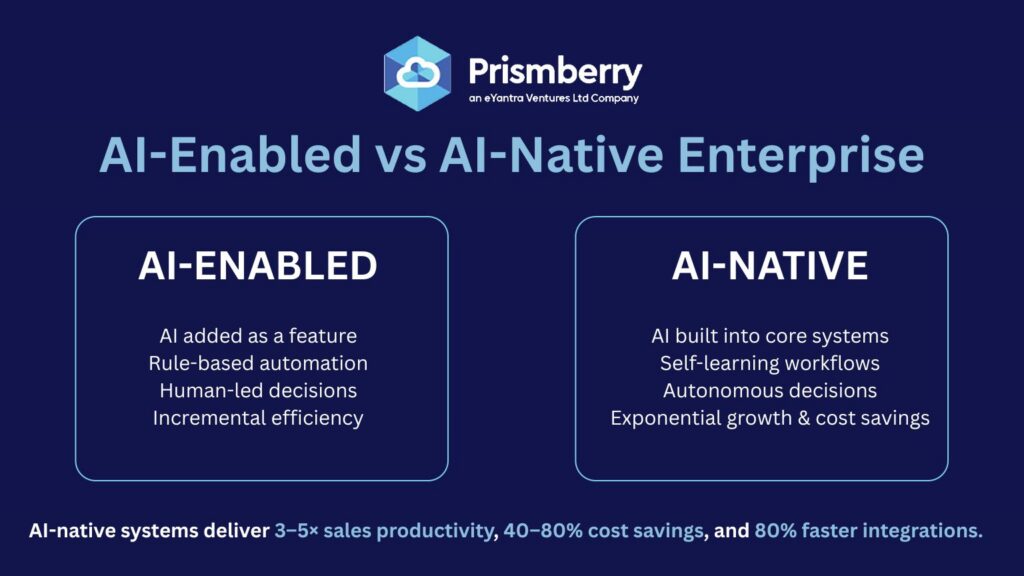
For years, enterprises invested in “AI-enabled” tools, traditional software with machine learning sprinkled on top. A CRM with predictive scoring. A chatbot that answers FAQs. These additions helped, but they didn’t transform.
AI-native products are fundamentally different. They don’t bolt intelligence onto existing processes; they reimagine those processes from the ground up. Consider lead generation: traditional automation executes predefined tasks while AI-native systems continuously analyze prospect signals, adapt messaging in real-time, learn from every interaction, and autonomously orchestrate entire revenue workflows. The result? Sales teams see 3-5× improvements in response rates while reducing manual SDR work by 60-70%.
The pattern repeats across enterprise functions. Where traditional systems record, AI-native systems understand. Where automation executes, AI-native products reason.
Four Pillars of AI-Native Enterprise Infrastructure
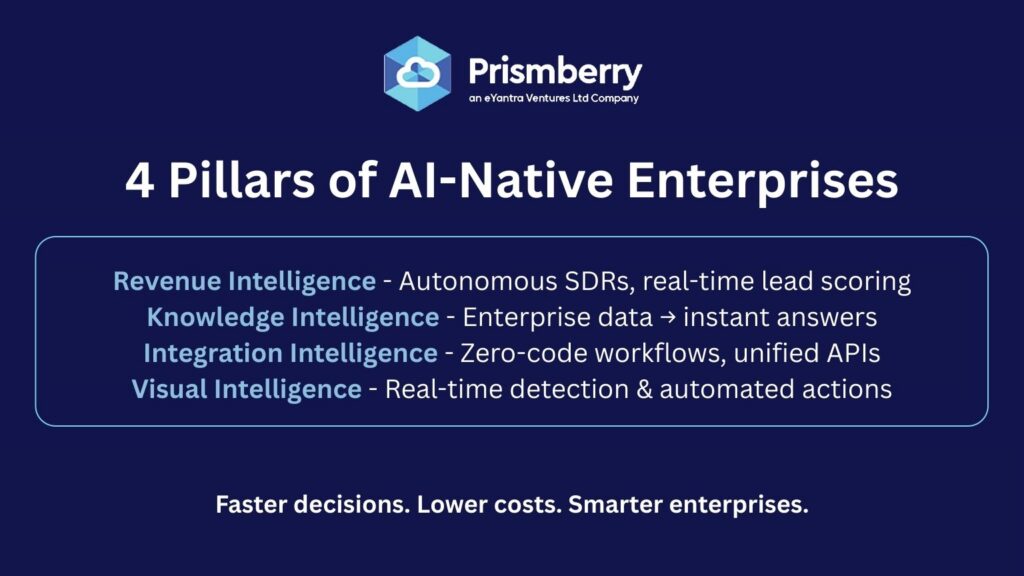
The enterprise landscape is crystallizing around four critical AI-native capabilities that together form the foundation of intelligent operations.
1. Autonomous Revenue Intelligence
The sales function offers perhaps the clearest example of AI-native transformation. Human bandwidth has always been the limiting factor in revenue growth. Sales teams spend 40-60% of their time on non-selling activities, research, data entry, list building, and follow-up tracking. This isn’t a training problem or a motivation issue. It’s a fundamental constraint of human-led processes. AI-native revenue platforms break this constraint. They operate as virtual SDR teams that never sleep, combining prospect intelligence agents that score and prioritize leads, research agents that gather contextual signals in real-time, personalization engines that craft 1:1 messaging at scale, and learning systems that continuously optimize based on outcomes. The result isn’t incremental improvement; it’s a shift from sales effort to sales intelligence, where the constraint moves from human capacity to market opportunity.
2. Enterprise Knowledge as Living Intelligence
Every enterprise sits on vast knowledge assets, documents, databases, communications, and systems, yet this knowledge remains largely inaccessible when decisions need to be made. Employees spend hours searching for information while critical insights stay buried in PDFs. AI-native knowledge platforms transform static repositories into living, queryable intelligence. Through retrieval-augmented generation (RAG), they maintain semantic understanding of all enterprise content, query live systems through natural language, and execute workflows based on what they know. The shift is profound: from information storage to intelligent action, from search to synthesis, from asking IT for reports to conversing with your entire knowledge base.
3. Universal Integration as Intelligence Layer
The average enterprise uses 50-200 applications, with each integration traditionally requiring 2-6 weeks of development time. This integration tax compounds exponentially with each new system. AI-native integration platforms transform integration from a technical task into a strategic capability. With unified API layers, visual automation builders requiring zero code, and intelligent workflow orchestration, organizations reduce integration time by 80% while cutting engineering costs by 40-60%.
4. Visual Intelligence at Machine Speed
90% of the world’s data is visual, cameras in factories, cities, warehouses, hospitals, vehicles, yet traditional systems merely record millions of hours of footage that humans cannot possibly monitor. AI-native visual intelligence platforms turn passive recording into active perception. They detect objects and events in real-time, understand behavior patterns, trigger automated responses, and learn continuously from feedback. Manufacturing facilities achieve 50% reductions in safety incidents, 70% efficiency gains in quality control, and 80% improvements in actionable insights. The principle extends beyond manufacturing: if it can be seen, it can be optimized.
The Enterprise Imperative: Why Now?
Three converging forces make AI-native transformation urgent, not optional.
First, competitive velocity has accelerated beyond human pace. Markets move faster, customer expectations shift overnight, and competitive advantages compress into shorter windows. Organizations that rely on human-speed decision-making increasingly find themselves reacting to AI-speed competitors.
Second, the economics have fundamentally shifted. AI-native platforms deliver 40-80% cost reductions with simultaneous quality improvements. This isn’t marginal optimization, it’s a structural advantage that compounds over time. As one executive noted, “We’re not competing on who has better people anymore. We’re competing on who has better intelligence systems augmenting their people.”
Third, data volumes have exceeded human comprehension. The explosion of SaaS applications, IoT sensors, customer touchpoints, and operational systems generates more data than any human team can synthesize. AI-native systems don’t just handle more data, they make sense of it in context, in real-time, and at scale.
The Future Is Already Here
The question facing enterprises in 2026 isn’t whether to adopt AI-native products; it’s how quickly they can transition before competitors establish insurmountable advantages. The companies thriving today have recognized that AI-native isn’t a feature set. It’s a fundamental reimagining of how work gets done.
Revenue teams operate as intelligence networks, not human pipelines. Knowledge becomes instantly accessible and actionable, not buried in documents. Integrations happen in minutes, not months. Visual data transforms into automated decisions, not stored footage.
For enterprises serious about transformation, the message from AI Impact Summit 2026 is clear: the future belongs to organizations that don’t just use AI, they’re built on it. The gap between AI-enabled and AI-native is the gap between incrementalism and transformation. And that gap is widening every day.
The future of enterprise transformation isn’t about doing the same things faster. It’s about reimagining what’s possible when intelligence becomes infrastructure. AI-native products aren’t coming, they’re here. The only question is whether your enterprise is ready to build on them.