
For years, Artificial Intelligence has been a powerful tool, performing tasks like pattern recognition, data analysis, and content generation with speed and accuracy far beyond human capacity. Traditional AI, including early machine learning models and even first-generation chatbots, was characterised by its reactiveness. It waited for a command, processed the input, and delivered a result, much like a highly efficient calculator.
Today, we are witnessing a fundamental shift, moving AI from a passive tool we use to a proactive partner we collaborate with. This seismic change is driven by the emergence of Agentic AI. Understanding this difference is not just an academic exercise; it is crucial for every business planning its digital future. The move to Agentic AI represents the next major value driver in technology, particularly for companies looking for sophisticated artificial intelligence development services to achieve complex, multi-step business goals.
This blog explores the key functional differences between the two paradigms, examines what agentic AI is at its core, and discusses how the rapidly evolving Indian tech ecosystem is positioned to lead this global change.
The Defining Split: Reactive vs. Proactive
To appreciate the gravity of the shift, one must first grasp the core limitations of the AI systems that dominate the current business landscape:
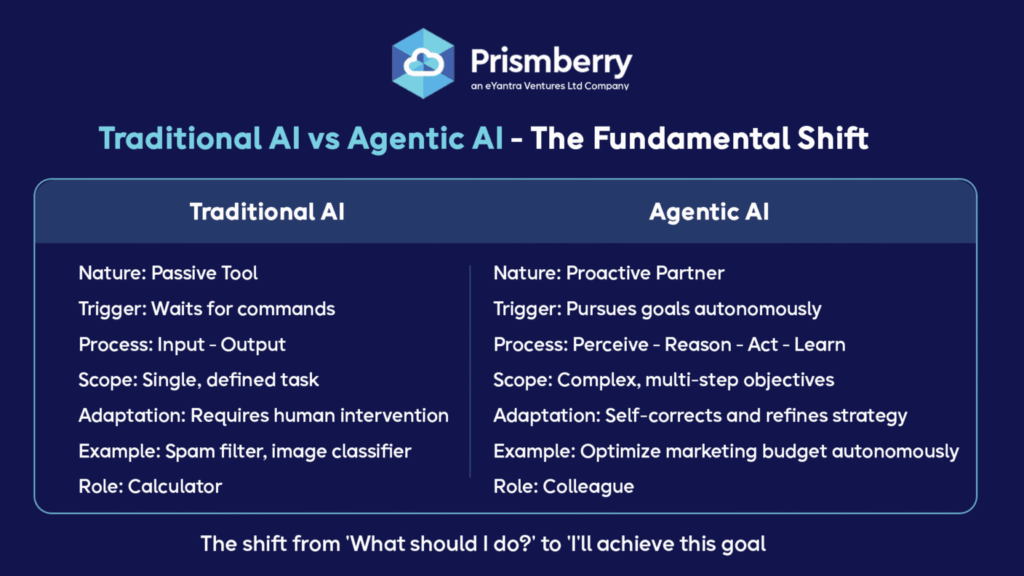
The Traditional AI Approach: A Tool in Hand
Traditional AI, often referred to as Narrow AI, excels at a specific, defined task. Think of the spam filter in your email, the recommendation engine on a streaming platform, or an algorithm classifying images.
- Execution: It operates on a fixed set of rules or a trained model.
- Input-Output Loop: It requires a clear, human-provided input to generate a single, specific output.
- Decision-Making: Decisions are based on probability or rules within a narrow, pre-coded domain. It cannot formulate a strategy or deviate from its predefined path.
While incredibly valuable for efficiency, traditional AI remains a tool. It relies entirely on human direction and cannot adapt to unforeseen circumstances beyond its training data without human intervention.
The Agentic AI Approach: The Digital Partner
Agentic AI, on the other hand, is an AI system designed to act with a degree of autonomy in pursuit of complex, high-level goals. It does not wait for a step-by-step instruction but works to achieve an outcome.
A simple prompt like “Optimise our quarterly social media campaign budget” transforms from a data analysis request (Traditional AI) into a multi-step project (Agentic AI). The Agentic system will:
- Reason: Break the goal into sub-tasks (e.g., check current ad performance, analyse competitor spend, test new creative).
- Plan: Order and prioritise the sub-tasks, identifying necessary external tools (like an API connection to the ad platform or a budget spreadsheet).
- Act: Execute the plan, making real-time decisions, such as automatically pausing underperforming ads or allocating more budget to a high-converting channel.
- Learn: Record the outcome of its actions, incorporating the feedback into its strategy to improve future performance without requiring explicit retraining.
This autonomous, four-step process, Perceive, Reason, Act, and Learn, is what truly sets Agentic AI apart, turning AI from a passive algorithm into a proactive entity.
The Architecture of Autonomy: How Agentic AI Works
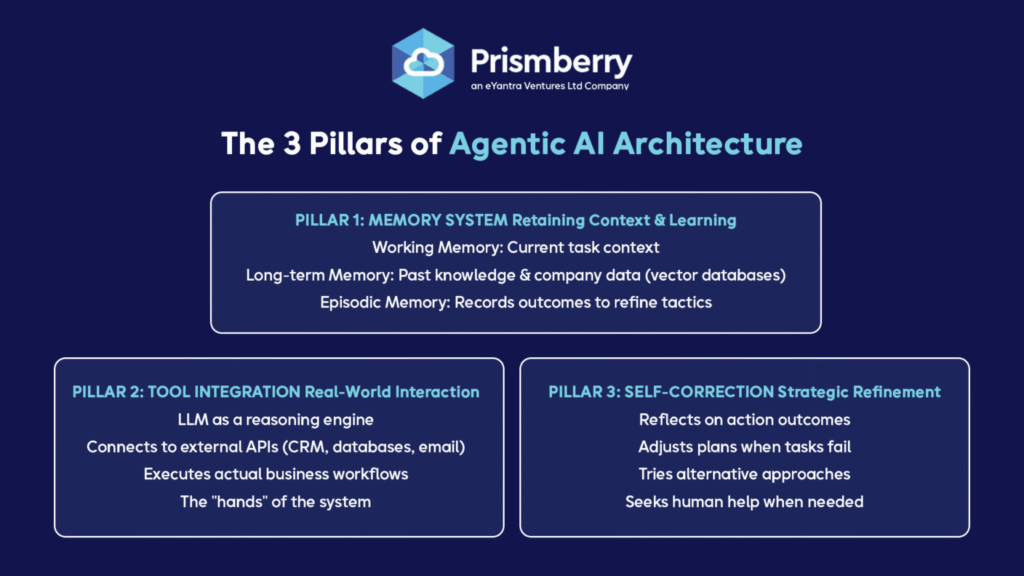
The shift to agency is less about a single technological breakthrough and more about a new system architecture built upon large language models (LLMs). The components that make Agentic AI functional include:
1. Memory and Context Retention
Unlike a chatbot that forgets the conversation after the session ends, an AI agent needs long-term memory to learn. This involves:
- Working Memory: For the immediate task context.
- Long-term Memory (Vector Databases): Storing past knowledge, project details, and company-specific data that informs future decisions.
- Episodic Memory: Recording specific, critical past events and their outcomes, allowing the agent to refine its tactics over time.
2. Tool Use and External Interaction
To perform real-world tasks, an Agentic AI must be able to interact with software outside its own code. It uses the LLM as a “reasoning engine” to decide which external tool (e.g., a CRM, an email client, a database query tool) to call, how to format the input for that tool, and how to interpret the tool’s output to continue its planning. This interaction ability gives the AI agents the “hands” to execute real business workflows.
3. Reflective and Self-Correction Loops
A crucial feature is the agent’s ability to self-critique. After attempting an action, it can use the LLM to reflect on whether the action moved it closer to the goal. If a task fails or produces a suboptimal result, the agent doesn’t just stop; it can adjust its plan, try a different approach, or even ask a human for help, showing a level of strategic reasoning previously confined to human managers.
The Indian Tech Nexus: Leading the AI Agent Wave
The global development race for Agentic AI places a significant focus on countries with deep talent pools and strong track records in software services. India is uniquely positioned at the epicentre of this transformation. The concentration of technical expertise, experience in scaling complex digital solutions for global enterprises, and a strong culture of innovation make India a powerhouse for advanced AI development. Companies are rapidly evolving their offerings from providing basic machine learning solutions to comprehensive, bespoke Agentic deployments. Finding the top AI company in India today means identifying partners that have already transitioned their focus to building sophisticated, multi-agent systems, solutions that address high-value problems like autonomous cloud cost optimisation, personalised financial planning, or self-correcting supply chain management. The shift is already underway, as evidenced by a marked increase in demand for next-generation artificial intelligence development services that deliver genuine autonomy rather than mere automation. This talent density and domain experience are why major global enterprises are increasingly relying on Indian firms to build the foundations of their AI-driven future.
Practical Implications: From Assistants to Colleagues
The real-world impact of Agentic AI is moving rapidly beyond hypothetical concepts. Companies deploying these systems are seeing dramatic shifts in productivity:
- Software Development: AI agents can break down feature requests, write code for sub-components, test the code, and even debug issues based on failure reports, significantly accelerating the development cycle.
- Customer Operations: Instead of a simple chatbot, an AI agent can analyse a customer’s history, identify the root cause of an issue across multiple systems, and autonomously initiate a refund or schedule a service appointment.
- Data Analysis and Compliance: Agents can continuously monitor data streams for anomalies, automatically generate compliance reports, and autonomously flag and resolve potential security issues without waiting for human analysts.
This technology does not replace the human worker; it dramatically elevates their role. When AI handles the complex, multi-step execution, human employees are freed to focus on strategy, creative problem-solving, and the critical tasks that require emotional judgment and complex ethical reasoning.
The Road Ahead
The era of Agentic AI is here, fundamentally redefining the nature of work. The key to staying relevant is not merely adopting AI, but adopting autonomous AI, systems that can work toward a goal, think strategically, and use tools effectively. For businesses worldwide, partnering with experienced providers, especially the top AI company in India, will be essential for navigating the complexities of this new wave of autonomy and turning ambitious goals into actionable, automated realities.
FAQs
Generative AI is reactive and focused on creating content (text, images) based on a human prompt; Agentic AI is proactive and focused on making decisions and taking actions to achieve a complex, multi-step goal autonomously.
Agentic AI can make mistakes, often due to faulty reasoning or incorrect tool usage. To mitigate this, developers use safeguards like human oversight, defined constraints, and constant self-correction loops where the agent must reflect on and justify its actions.
The fastest adoption is happening in software development, financial services (for automated trading and compliance), and logistics/supply chain management, where multi-step, autonomous process optimisation delivers immediate, measurable value.