
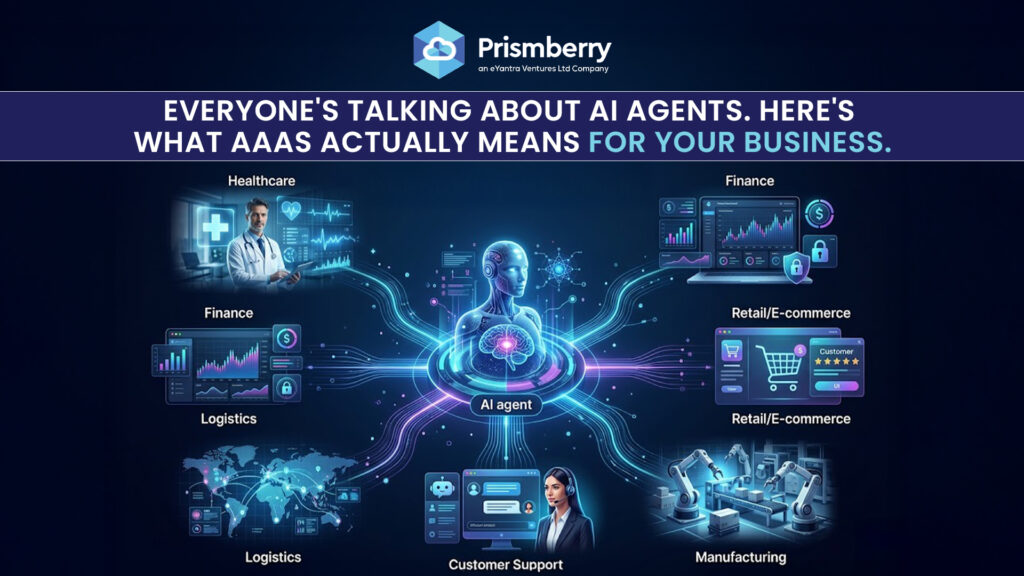
What if your business had a digital worker that never sleeps, never makes mistakes, learns fast, and costs much less than a human?
This is not science fiction anymore. This is Agent as a Service (AaaS).
Today, many companies struggle with repetitive tasks. Customer queries keep piling up. Reports get delayed. Teams switch between tools that don’t connect well. Even with modern software, people still have to do most of the work.
AaaS changes this completely.
Instead of giving you just another tool, AaaS gives you an AI agent that works for you. It can think, plan, act, and improve in real time. It doesn’t wait for instructions—it gets the job done.
And this shift is already happening. Companies are rapidly exploring agent-based AI, and experts predict that a large number of business applications will soon include these smart agents.
This guide will help you understand everything about AaaS—what it is, how it works, how it is different from SaaS, its benefits, real-world uses, and how your business can get started.
1. What Is Agent as a Service (AaaS)?
In Agent as a Service (AaaS), autonomous AI agents (capable of reasoning, decision-making and multi-step task execution) are delivered to businesses as a service (via subscription or API), furthermore, without necessitating businesses to develop or maintain the underlying AI infrastructure.
In contrast to a traditional software, which just waits until a human operator inputs their command, an AaaS agent is proactive in goal interpretation, action planning, integrating with other tools, and performing tasks to completion, and with little or no human oversight.
AaaS sits at the convergence of four fast-maturing technologies:
- Large Language Models (LLMs) The logic machine (GPT-4, Claude, Gemini)
- Cloud infrastructure – allow scalable on-demand deployment of agents.
- API ecosystems API links She connects agents to your current business applications.
- ML and NLP – allows agents to learn and comprehend natural language based on their results.
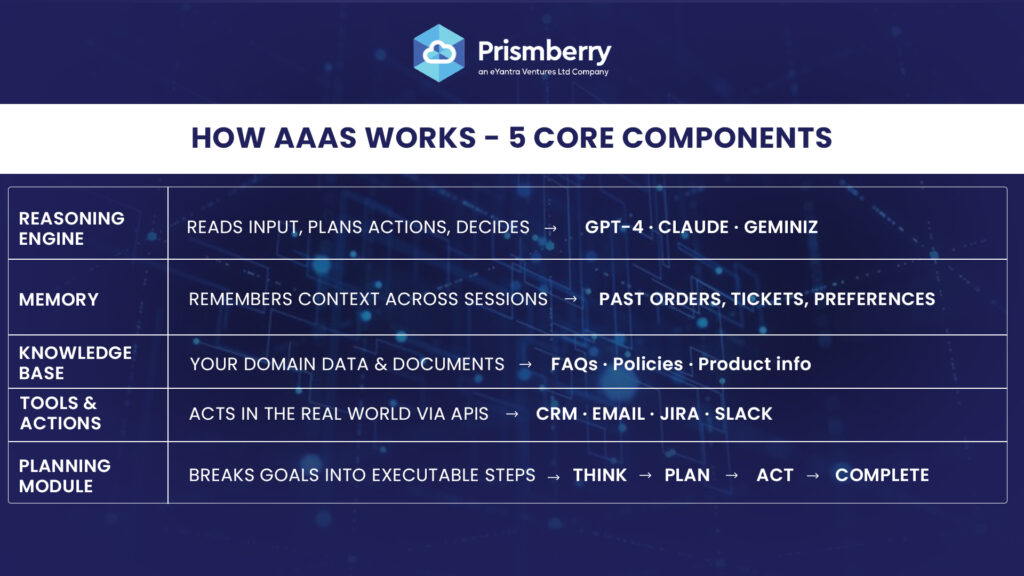
2. How Does AaaS Work? Core Components
All Agent-as-a-Service systems are based on five fundamental elements that collaborate to allow autonomous tasks to be executed:
| Component | Role | Example in Action |
| Reasoning Engine (LLM) | The brain — interprets input, plans actions, makes decisions | Agent reads a customer complaint and decides the appropriate resolution path |
| Memory (Short & Long-Term) | Retains context within a session and across interactions | Agent recalls a customer’s past orders when handling a new support ticket |
| Knowledge Base | The agent’s personal library of domain data and documents | Agent queries your product FAQ to answer customer questions accurately |
| Tools & Actions | APIs and integrations that let the agent act in the real world | Agent updates your CRM, sends an email, and creates a Jira ticket automatically |
| Planning Module | Breaks high-level goals into executable sub-tasks | Agent decomposes ‘generate monthly report’ into data retrieval, analysis, and formatting steps |
3. AaaS vs. SaaS: What’s the Real Difference?
The biggest question that business leaders start with regards to AaaS and SaaS. The following is the best breakdown:
| Dimension | SaaS | AaaS |
| What you get | A software tool to use | An AI agent that does the work for you |
| Human input required | High — you operate the interface | Minimal — agent operates autonomously |
| Automation depth | Basic rule-based workflows | End-to-end multi-step task execution |
| Adaptability | Fixed, predefined functionality | Learns and adapts from interactions |
| Pricing model | Subscription per seat/feature | Outcome-based or consumption-based |
| Integration | Connects to other tools manually | Autonomously integrates across your stack |
| Example | HubSpot CRM (you manage contacts) | AI agent manages CRM, follows up leads, logs calls |
4. Types of AI Agents in AaaS
- Task Agents: Process individual, narrowly-focused tasks that are executed based on a single input – email summarization, form filling, report generation. Stateless and fast.
- Conversational Agents: Participate users in multi-turn channel dialogue. Keep session memory to contextual human like interaction.
- Workflow Agents: Coordinate business processes with multiple steps including sales follow-up regimes, document reviews associated with compliance.
- Multi-Agent Systems (MAaaS): Several qualified agents work concurrently, one of them is responsible to communicate, another one analyses information, and the third agent renews systems. Perfect with elaborate enterprise processes.
- Autonomous Research Agents: Surf the internet, access data, generalise results, and present organised reports without supervision.
5. Key Benefits of Agent as a Service
24/7 Operations Without Overhead
AaaS representatives do not sleep, take breaks, or go on sick leave. According to businesses that use AI agents, their operational efficiency has increased by 20-30%. In the case of customer-facing teams, 8 out of ten problems are supposed to be handled without a person in the coming years.
Outcome-Based Pricing
AaaS, unlike SaaS, is more and more outcome-based in its pricing, i.e. by the number of resolved tickets, transactions, or report generated. This aligns the incentives of the vendors directly to business value 55 percent of the organizations currently prefer usage-based pricing of AI agents.
No Infrastructure Investment
Conventional AI undertaking projects need to invest large amounts in hardware, data scientists, and model training. AaaS eliminates all of that. Businesses subscribe and put it into deployment – usually in days not months.
Scalability Without Headcount
AaaS is horizontally scaled according to demand. An influx of requests, and a spurt in orders, or an unexpected compliance date – the agent takes it in without the need to hire (freeze) or pay overtime.
Continuous Improvement
AaaS vendors keep increasing and updating the underlying AI models. Businesses can always use the current model capabilities without keeping track of updates, retraining, and upgrades of infrastructure.
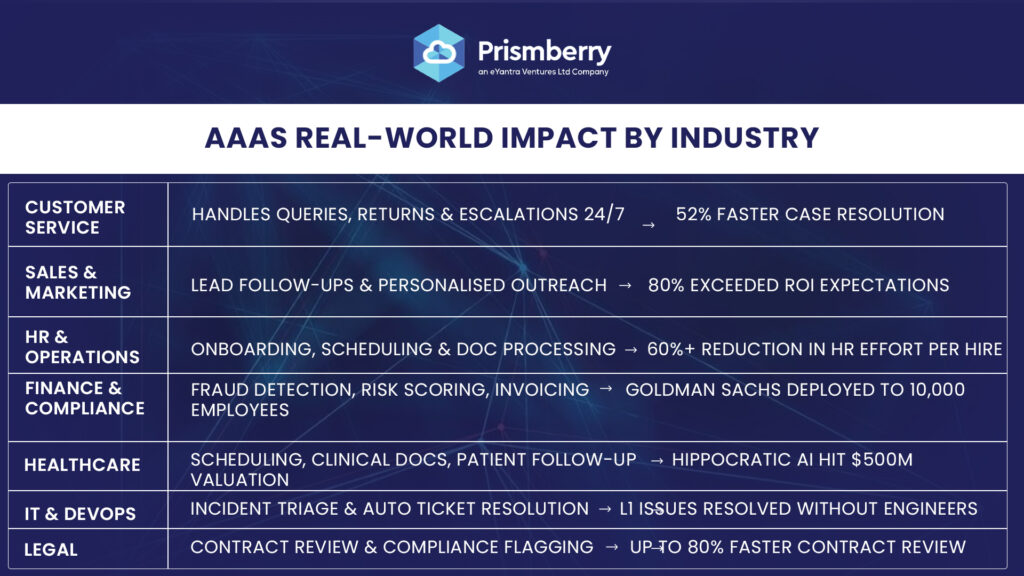
6. Top AaaS Use Cases by Industry
| Industry | Use Case | Business Impact |
| Customer Service | 24/7 AI support agents handling queries, returns, escalations | ServiceNow reported 52% reduction in case resolution time |
| Sales & Marketing | Lead enrichment, follow-up sequences, personalized outreach | 80% of marketers say AI tools exceeded ROI expectations (2025) |
| HR & Operations | Onboarding automation, benefits FAQs, scheduling, document processing | Fortune 500s report 60%+ reduction in HR effort per hire |
| Finance & Compliance | Fraud detection, risk scoring, audit trail generation, invoice processing | Goldman Sachs deployed AI agents to 10,000 employees in 2025 |
| Healthcare | Appointment scheduling, clinical documentation, patient follow-up | Hippocratic AI surpassed $500M valuation on healthcare AaaS |
| IT & DevOps | Incident triage, root cause analysis, automated ticket resolution | Agents resolve L1 issues autonomously, freeing engineers for L2/L3 work |
| Legal | Contract clause detection, NDA review, compliance risk flagging | LLM-based agents cut contract review time by up to 80% |
7. Challenges & Considerations
- Trust & Accuracy: 60% of organizations lack full trust in AI agents and confidence in full autonomous agents dropped down to 22% as compared to 43% in 2024. HITL supervision is imperative when it comes to decisions that matter.
- Security: 62% of the practitioners mention security as a number one challenge. Strict access controls, audit logging and zero-trust architecture are necessary to agents that access external APIs and internal data.
- Regulatory Compliance: The EU AI Act sets rigorous conditions on the autonomous AI system, fines of EUR 35 million. AaaS implementation should be designed to establish compliance in the governance structure.
- Integration Complexity: Connecting agents to legacy enterprise systems can be technically challenging. 87% of IT leaders say smooth integration with other intelligent tools is critical to adoption success.
Prismberry’s Role in the AaaS Evolution
At Prismberry, we are not just talking about Agent as a Service (AaaS) — we are building and improving it every day. Our focus is simple: make AI agents useful, reliable, and easy to use for real businesses.
Here’s how we are contributing:
- Building AI-first products
We are creating AI-native solutions like AgentIQ, VisionIQ, RevenueIQ, and Pluggy. Each product solves real problems — from automation and insights to smarter decision-making. - Making AI simple for businesses
We design agents that fit into your daily work. You don’t need to change everything — the AI works with your existing tools and processes. - Focusing on real use, not just demos
Our goal is to build systems that actually work in real situations, not just look good in presentations. - Improving agents over time
Our AI agents keep learning from real data and usage. This helps them become more accurate and useful as your business grows. - Connecting everything smoothly
We make sure our agents can work with tools like CRM, ERP, and communication platforms, so your workflow stays simple and connected. - Keeping things safe and reliable
We pay close attention to data security, privacy, and compliance, so businesses can trust the systems they use. - Preparing for the future of work
As AaaS grows, we are building systems where multiple AI agents can work together and handle complex tasks easily.
In a nutshell, Prismberry’s role is to help businesses move from just trying AI to actually using it in a meaningful way.
Next Step
Agent as a Service (AaaS) is not just another tech trend. It is a new way of getting work done.
Instead of using software step by step, businesses can now rely on AI agents to handle complete tasks — from start to finish. This shift can save time, reduce manual effort, and help teams focus on more important work.
Today, many companies are already testing and using AI agents in areas like customer support, sales, and operations. The results are clear: faster processes, better efficiency, and improved decision-making.
At the same time, it is important to adopt AaaS in a smart way. Businesses should start small, choose one high-impact use case, and measure results before scaling further. This helps reduce risk and build trust in the system.
The future of work will not be about humans vs AI. It will be about humans working alongside AI agents to achieve better outcomes.
So, the real question is not whether you should explore AaaS, but where you should begin.
Start simple. Learn fast. Scale wisely.
Frequently Asked Questions (FAQs)
A: Agent as a Service (AaaS) is a cloud-based model in which autonomous AI agents — powered by LLMs, machine learning, and NLP — are delivered to businesses via subscription or API. These agents can reason, plan, and execute multi-step tasks independently, without constant human input.
A: SaaS provides software tools that humans operate. AaaS provides AI agents that operate on your behalf. SaaS gives you a CRM, AaaS manages your customer relationships autonomously. The key distinction is autonomy: AaaS agents take end-to-end ownership of workflows, not just individual steps within them.
A: Not entirely, but it will significantly augment and disrupt it. Gartner predicts agentic AI will drive 30% of enterprise application software revenue by 2035. Many SaaS platforms are already embedding agents into their products. The future is likely a hybrid: SaaS tools with AaaS agents layered on top to automate the work within them.
A: The most impactful AaaS use cases include customer service automation, sales lead management, HR onboarding, financial compliance monitoring, IT incident triage, legal contract review, and healthcare appointment scheduling. Any workflow that is repetitive, rule-driven, and data-intensive is a strong candidate for an AI agent.
A: Yes, with the right implementation. Enterprise AaaS deployments require strict access controls (RBAC), audit logging, zero-trust API security, and compliance with regulations like GDPR, HIPAA, and the EU AI Act. 62% of practitioners cite security as a top concern — which is why governance frameworks must be built in from day one, not added retroactively.