Introduction
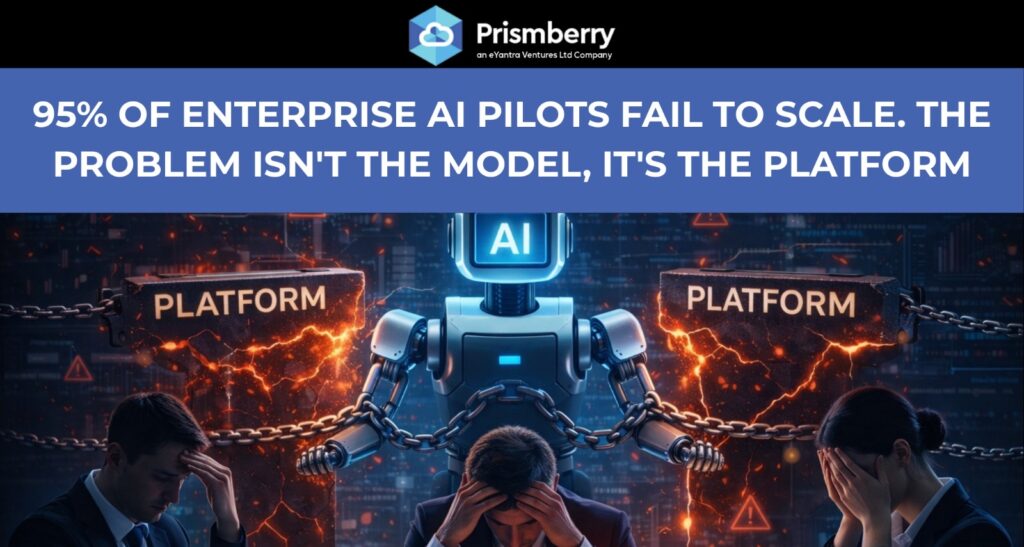
Three quarters of businesses are now applying AI – but 95% of AI generative pilots do not generate fast, scalable outcomes. The gap is not a model problem. It is a platform problem.
The majority of enterprises attempt to operate next-generation AI with last-generation software: platforms that are designed with strict workflows, fixed rules, and combined AI functionalities. They, in fact, require AI-native systems – systems that are developed as intelligent ones rather than as systems that are added with intelligence as peripheral.
This guide describes the concept of AI-native platforms and their difference in architecture compared to traditional software, who are the leaders in the market in 2026, and how to select and construct the correct AI-native solution to your business.
1. What Are AI-Native Platforms?
An AIN platform is an AIN platform: artificial intelligence is a fundamental, trusted feature, embedded naturally into all components of the system, both in its operations and implementation, and in its maintenance and optimization, and not a feature added atop it.
In contrast to the AI-enabled software (where AI functionality is added to an existing system), AI-native platforms are designed with AI in mind. All the data flows, decision points, and user interactions are planned to utilize machine intelligence. The platform is not only AI-friendly but it relies on AI in order to operate.
In practice, this means AI-native platforms:
- Let feedback loops and real-time learning keep changing you – there is no need to have updates on a schedule.
- Handling process data as a flowing continuous resource instead of fixed input.
- Workflow automation, not limited to task level automation.
- Support agentic behavior – acting on your own according to stipulated goals and policies.
- Bring AI to the market as customizable services (AIaaS) that are demands of internal teams and third parties.
2. AI-Native Architecture: How It Works
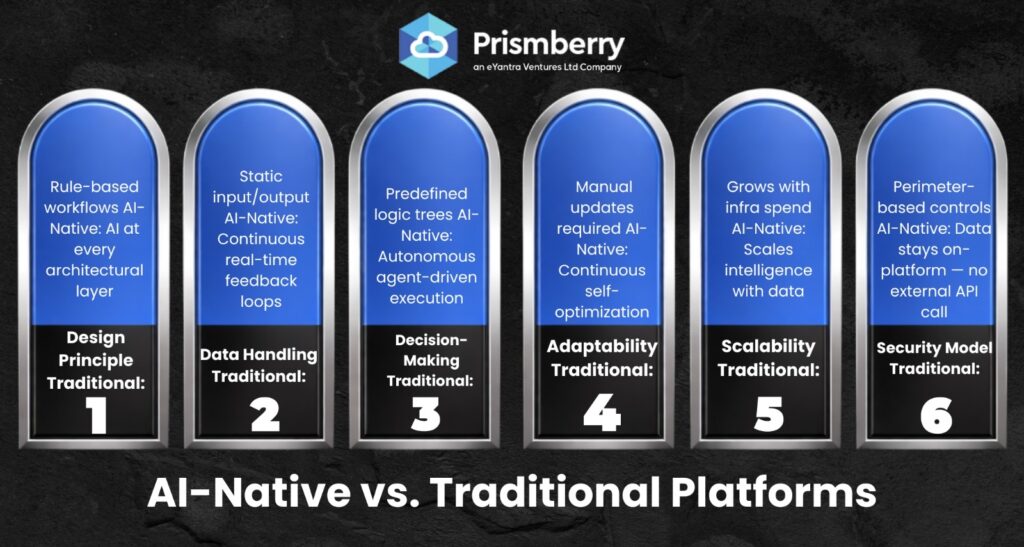
AI-native architecture refers to the fact that AI is spread across the whole system, and not just in a single layer or feature. The structural difference between it and conventional software and AI-powered platforms is as follows:
| Dimension | Traditional Platform | AI-Enabled Platform | AI-Native Platform |
| Design Principle | Rule-based workflows | AI added to specific modules | AI at every architectural layer |
| Data Handling | Static input/output | AI-enhanced queries | Continuous real-time feedback loops |
| Decision-Making | Predefined logic trees | AI-assisted suggestions | Autonomous agent-driven execution |
| Adaptability | Manual updates required | Periodic model retraining | Continuous self-optimization |
| Scalability | Grows with infra spend | Constrained by legacy core | Scales intelligence with data |
| Security Model | Perimeter-based controls | API-dependent (external AI calls) | Local models, data stays on-platform |
One of the main architectural benefits of AI-native platforms compared to AI-powered ones: they execute AI models on such infrastructure. Critical enterprise data will not be moved out of the platform environment – this is absolutely essential when an industry requires data sovereignty to be established.
3. AI-Native vs. Traditional Platforms: Why It Matters
The Workflow Execution Gap
Traditional platforms are used to perform workflows through specific pre-defined processes – who authorizes what, when, in what sequence. AI-native platforms characterize the result and allow the system to decide dynamically how to achieve this result based on real-time information, coded business policies, and situational awareness.
The Adaptability Gap
The traditional software involves IT intervention to modify behavior. AI-native SaaS systems study all interactions they receive and keep improving their models with no human involvement needed. This builds up to a high competitive edge in the long run because the platform will be more precise and effective.
The Developer Productivity Gap
According to the projections given by Gartner, 70 percent of new enterprise applications will be constructed on and with low-code or no-code technologies as soon as 2025. This is enabled by AI-native development systems and prompt-based app generation, visual builders, and intelligent code completion which will speed up AI-native software development processes significantly.
4. AI-Native Applications: Real-World Examples
- E-Commerce Personalization: Amazon has a recommendation engine, a typical AI native application, that generates 35 percent of the total revenue by handling the browse history, buying time, and user information in real-time with no clear instructions.
- Cybersecurity: AI-native security systems are able to detect new threats and react quicker than human analysts, and keep up with emerging patterns of attack, which are essentially impossible to achieve with rule-based systems.
- Healthcare Intelligence: Federated AI-native technologies learn on patient data in thousands of hospitals without trading on individual records, discover diagnostic correlations that would require decades to identify manually.
- Software Delivery: AI-native CI/CD systems forecast risky deploys, automatically run targeted tests, and roll-back failures – changing DevOps into a human-operated system into a self-managed one.
- Enterprise Analytics: AI based BI systems such as ThoughtSpot, provide users with natural-language queries and immediate visualization – days of dashboard creation are swapped with seconds of conversation query.
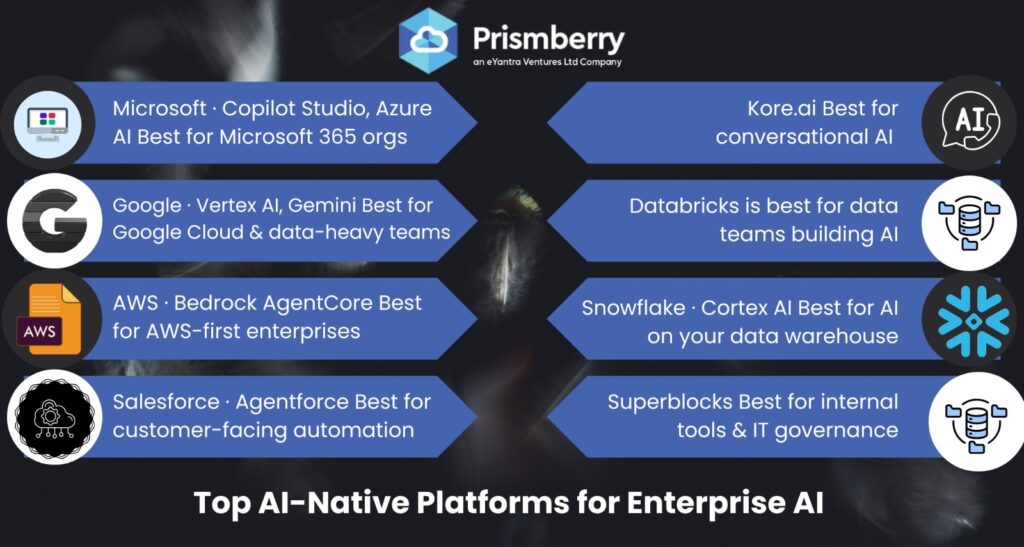
5. Top AI-Native Platform Providers for Enterprise AI in 2026
The horizontal platforms, ecosystem-based solutions, developer-oriented frameworks and purpose-built vertical platforms represent four types of enterprise AI-native platforms market. The following are the top providers in each:
| Provider | Category | AI-Native Strength | Best For |
| Microsoft (Copilot Studio, Azure AI) | Ecosystem-centric | AI embedded across Microsoft 365, Dynamics, Azure; AutoGen for multi-agent apps | Orgs deep in Microsoft stack |
| Google (Vertex AI, Gemini) | Ecosystem-centric | Multimodal AI, TPU-backed training, Agent Builder, BigQuery ML integration | Data-heavy, Google Cloud orgs |
| AWS (Bedrock AgentCore) | Ecosystem-centric | Native agent orchestration layer, deep AWS integration, Bedrock model access | AWS-centric enterprises |
| Salesforce Agentforce | Purpose-built vertical | AI agents embedded in CRM, sales, service, and marketing workflows natively | Customer-facing AI automation |
| Kore.ai | Horizontal enterprise | Gartner Magic Quadrant Leader (Conversational AI, 2025); RBAC, audit logs, full governance | Enterprise conversational AI |
| Databricks | AI development platform | MLflow-native, Delta Lake, AI/BI agent, cross-cloud MLOps | Data-driven AI development teams |
| Superblocks | AI-native internal tools | AI app generation with enterprise governance, RBAC, SSO, audit logs — all centralized | CIOs reducing shadow IT |
| Vellum AI | AI agent platform | Multi-model orchestration, no-code builder, evals, observability, governance; air-gapped deployment | AI agent development & testing |
| Glean | Knowledge & search | Forrester Leader; AI-native enterprise search across all internal apps and data sources | Enterprise knowledge management |
| Snowflake (Cortex AI) | AI data platform | NVIDIA partnership, in-warehouse ML, LLM functions, Cortex AI features natively in SQL | Data teams building AI on existing warehouse |
6. How to Choose an AI-Native Platform: 6 Key Criteria
- Governance & Compliance: Prefer platforms that have in-built RBAC, audit logging, and data residency controls, and explainability (particularly in regulated sectors (BFSI, healthcare). Governance is one particular area where the 10.6% of organizations who have implemented advanced agentic AI in compliance today is a key differentiator.
- True AI-Nativeness: Check that AI is incorporated at the architectural level – not a feature wrap. Question: is the platform different without AI, or is AI impossible to do without its fundamental operation?
- Data Security Model: AI-native on-premise cloud services retain your data on-platform, meaning your data is not sent to external APIs, which is essential when handling sensitive data enterprise and regulated use cases.
- Integration Breadth: The platform should connect to your current enterprise stack – ERP, CRM, data warehouse, and cloud provider, and internal APIs. The highest differentiator of consulting firms that strategize and engineering partners that ship is integration depth.
- Developer Experience: Assess the quality of the no-code builder, SDK, documentation, template library, and time-to-first-value. The most promising AI-first systems allow technical developers as well as semi-technical business users to construct safely within the IT governance.
- Scalability & Deployment Flexibility: Search through cloud, private VPC, on-premise deployment, and air-gapped. Most enterprise applications can use serverless, inference-first systems which can be automatically scaled between prototype and production.
7. How to Build AI-Native Applications for Your Business
| Phase | Timeline | Key Actions |
| Assess & Plan | Weeks 1–4 | Audit current stack, identify AI-ready use cases, select platform category (horizontal vs. vertical vs. custom) |
| Proof of Concept | Months 1–3 | Build 1–2 targeted AI-native apps, validate with real users, measure time-to-value vs. existing solution |
| Operationalize | Months 3–6 | Establish governance framework, integrate with enterprise data sources, implement RBAC and audit logging |
| Scale | Months 6–18 | Expand to additional use cases, enable self-service for business teams, optimize model performance and cost |
Why Choose Prismberry for AI-Native Platform Development?
At Prismberry, we are experts in the creation of enterprise AI-native systems that are not demos and pilots, but production-level, controlled, and scalable AI systems that meet your business operations.
- AI-Native by Design – We design intelligent platforms, with intelligence built at every tier, but not bolted in. All of our solutions are actually AI-native and not AI-washed.
- Enterprise Governance First – RBAC, audit logs, data residency and compliance frameworks are not added at the end of the deployment, but as part of every platform.
- Full-Stack Platform Engineering – Not an API or a frontend, but a whole platform – we are not selling parts, we are platform.
- Vendor-Neutral Expertise – We operate in AWS, Azure, GCP, and open stacks. We are not recommending a vendor relationship.
- AI Platform Consulting – Platform preparation testing, architecture designs, vendor selection, and on-hand implementation of AI-native development ventures.
- Proven Enterprise Delivery – We have assisted companies in BFSI, healthcare, logistics, and retail to transition AI pilots into AI-native production systems.
Conclusion
AI-native platforms are a paradigm shift in architecture, where software based on AI is an optional feature, and software that does not require AI is not possible. With the AI software platform market expanding to $296 billion by 2030, the winners will not be those that continue to add intelligence to old stacks retroactically to them despite having AI-based foundations, but rather those that develop AI-based foundations initially and only subsequently retrofit intelligence onto them.
You need to be seeking AI platform providers, designing AI platform development at the enterprise, or seeking AI platform consulting to speed up your process – you should select platforms with AI as the architecture, not the add-on.
Frequently Asked Questions (FAQs)
A: AI-native platforms are designed with artificial intelligence at their core, with all workflows and decisions centered on AI. Unlike AI-enabled platforms that add AI as a feature, AI-native platforms rely on their AI layer for functionality.
A: AI-powered platforms enhance software with features like chatbots and automation, while AI-native platforms are built with AI at their core, providing better adaptability, autonomy, and security by operating locally without external APIs.
A: AI-native architecture incorporates intelligence throughout, enhancing data management, decision-making, and user interaction. It enables real-time learning, autonomous behavior, federated training, and continuous self-optimization, surpassing traditional rule-based systems.
A: Top enterprise AI-native platforms in 2026 are Microsoft (Copilot Studio, Azure AI), Google (Vertex AI), AWS (Bedrock AgentCore), Salesforce (Agentforce), Kore.ai, Databricks, and Snowflake (Cortex AI). Choose according to your tech stack, use case, and compliance needs.
A: Key evaluation criteria include: built-in governance (RBAC, audit logs), true AI-nativeness, secure local data handling, integration with enterprise systems (ERP, CRM), developer experience, and flexible deployment options (cloud, on-premises, air-gapped).