
Financial institutions operate on a scale of complexity that few other industries match. They deal with vast, constantly shifting data streams, strict regulatory scrutiny, and the need for personalised customer interactions, all simultaneously. For years, artificial intelligence development services focused on discrete, siloed problems: a better fraud model here, a faster chatbot there.
Today, the technology has leapt forward, moving beyond isolated tasks to full-scale autonomous operations through Agentic AI in Finance. This is not just about using AI for a single function; it’s about building an interconnected ecosystem of intelligent software agents that collaborate to manage complex, end-to-end business processes. This structural shift, enabled by advanced agent architectures, is what will define the truly “intelligent enterprise” in the coming years.
Understanding these next-generation architectures is crucial for any bank aiming to move past incremental efficiency gains toward fundamental operational transformation. The challenge lies in architecting these secure, complex systems, a task increasingly being led by the top AI company in India, which specialises in enterprise-grade integration.
Moving Beyond the Single Agent: The Multi-Agent System
Traditional AI implementations often involve a single model (like a classifier or a predictor) designed for one job. Next-Gen Agent Architectures, however, operate using Multi-Agent Systems (MAS).
What is a Multi-Agent System?
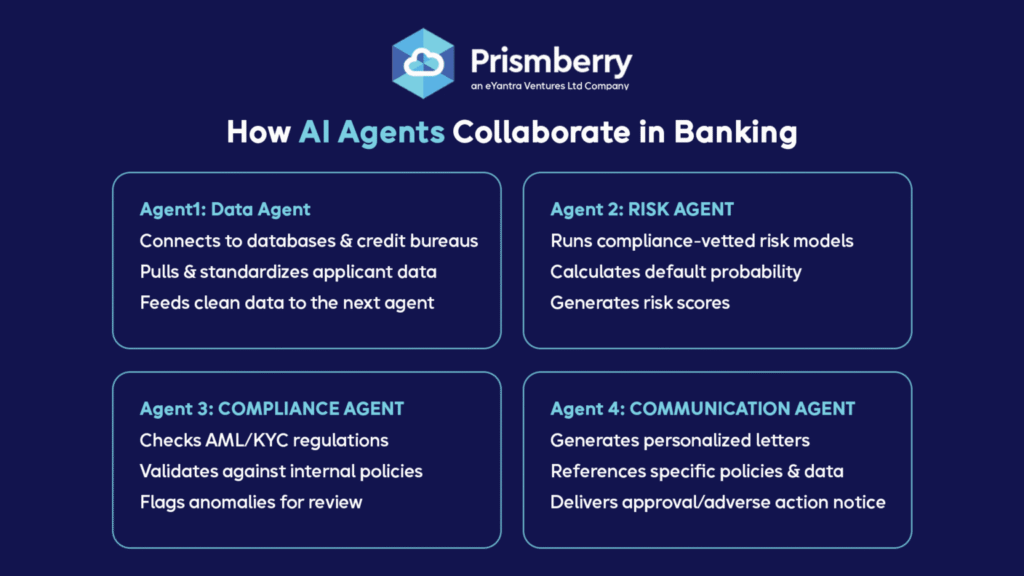
In an MAS, multiple, specialised AI agents, each with a defined role, memory, and set of tools, work together toward a shared, complex organisational objective. Instead of one powerful, monolithic AI, you have a team of cooperating experts. Consider the loan approval process:
- The Data Agent: Automatically connects to internal databases and external credit bureaus, pulling and standardising all necessary applicant data.
- The Risk Agent: Runs the data through a specialised, compliance-vetted model to calculate default probability and regulatory risk scores.
- The Compliance Agent: Checks the application and the risk score against current AML/KYC regulations and internal policy rules, flagging any anomalies.
- The Communication Agent: Generates the final, personalised adverse action notice or approval letter, referencing the exact policies and data points used.
Each agent handles its specialised task, passing context and output to the next. This architecture is faster, more auditable, and significantly more reliable because if one agent fails or needs updating, the entire system doesn’t collapse.
The Architecture Blueprint: Key Components
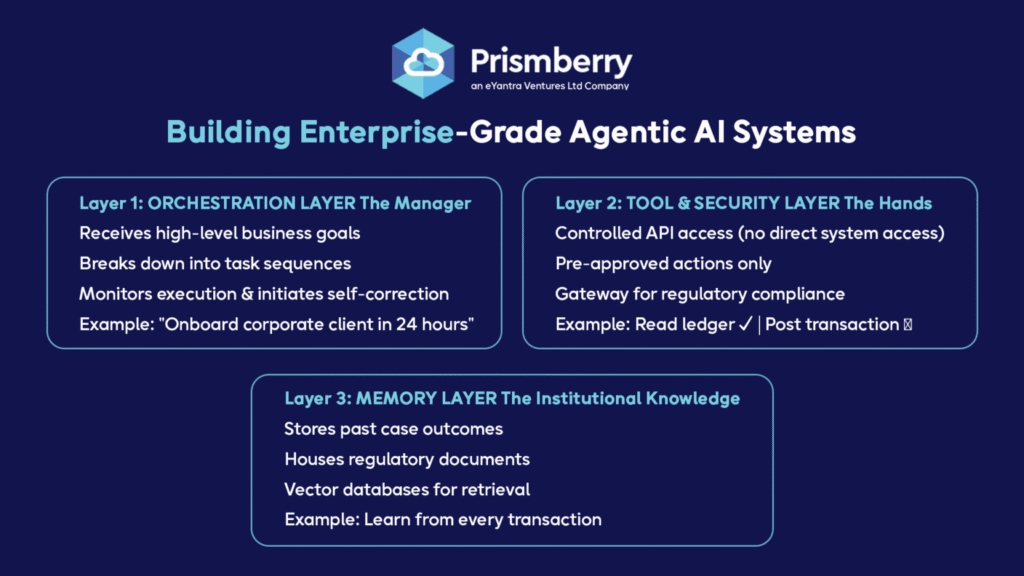
Building a secure, high-performing MAS for a bank requires a layered architecture that prioritises control and auditing:
1. The Orchestration Layer (The Manager)
This is the central planning unit. It receives the high-level business goal (e.g., “Onboard a new corporate client within 24 hours”), breaks it down into a sequence of tasks, and assigns those tasks to the specialised agents. It also monitors the execution, tracks progress, and initiates self-correction loops if an agent runs into an error. This layer ensures the entire process stays aligned with the overall objective.
2. The Tool and Security Layer (The Hands)
This is the critical defence perimeter. Agents are not granted direct, wide-open access to the bank’s core systems. Instead, they are given limited access through secure, pre-approved APIs (tools). This layer acts as a gateway, strictly controlling which data the agent can access and which actions (e.g., reading a ledger, but not posting a transaction) it can perform. This separation is paramount for regulatory compliance and preventing unauthorised operations.
3. The Memory Layer (The Institutional Knowledge)
For agents to act intelligently, they need more than just the current context. They need access to institutional memory, past case outcomes, regulatory documents, and proprietary knowledge bases, stored in secure vector databases. This allows the agentic AI in the Finance system to learn from every previous transaction, improving its decision-making over time without human intervention.
The Transformation: Agentic AI in Finance Use Cases
The move to Agentic Architectures unlocks operational capabilities previously unattainable through simple automation:
- Autonomous Fraud Response: Instead of merely detecting fraud, an agent system can: detect the suspicious transaction, instantly lock the affected account, automatically notify the customer, generate the required regulatory report, and update the fraud detection model, all in seconds.
- Real-Time Regulatory Compliance: Compliance agents constantly monitor changes in global financial regulations. If a rule changes, the system can automatically identify all affected internal models and workflows, flagging them for immediate human review and providing the initial remediation plan.
- Hyper-Personalised Wealth Management: Multi-agents monitor market fluctuations, client risk tolerance, and portfolio performance in real time. They can autonomously rebalance a portfolio within predefined limits and generate a bespoke, highly personalised communication explaining the actions taken.
This capability moves AI in Finance from a support function to a driving force, turning routine, complex operational expenditures into highly efficient, automated functions.
The Delivery Factor: Choosing the Right Partner
Implementing a Multi-Agent System in a heavily regulated industry like finance is challenging. It requires a rare blend of deep knowledge in AI/LLM technology, enterprise systems integration, and global financial compliance. This convergence of expertise is a core strength of the top AI company in India.
Firms in India have a proven track record of handling the scale and security required by major international banks. They are adept at:
- Compliance-First Architecture: Building systems that are auditable, explainable, and designed to meet global financial regulations from the first line of code.
- Legacy System Integration: Connecting new Agentic AI frameworks seamlessly with existing core banking systems and legacy infrastructure.
- Talent Scalability: Providing large teams of specialised developers, data scientists, and security architects required to architect and maintain these sophisticated MAS deployments.
Choosing the right artificial intelligence development services partner is paramount, as the integrity of the architecture determines the security and compliance of the entire automated operation.
The Next Era of Banking
The future of banking is autonomous, orchestrated by highly intelligent, cooperative agents. Agentic Architectures are the mechanism by which banks will achieve true operational scalability, flawless compliance, and unprecedented speed. By focusing on multi-agent systems, secure orchestration, and memory, financial institutions can begin the crucial work of building the self-managing, intelligent enterprise that is ready for the demands of tomorrow.
FAQ’s
Agentic AI is the concept of a single intelligent entity pursuing a goal autonomously; an MAS is the architecture where multiple specialised AI agents collaborate to achieve a single, complex organisational goal.
Yes. It is being tested and implemented in high-value, high-compliance areas like fraud detection, anti-money laundering (AML) operations, and trade reconciliation, where automation offers clear security and speed advantages.
The Orchestration Layer and Security Gateways are the most important, as they dictate which tasks agents can perform, ensure human oversight where needed, and guarantee that all actions comply with regulatory rules and security protocols.