The AI That Doesn’t Just Talk… It Acts
What if your AI assistant didn’t just answer questions, but actually did your work?
Imagine sending a WhatsApp message like:
“Schedule my meetings, reply to emails, and pull today’s sales report.”
And it just… happens.
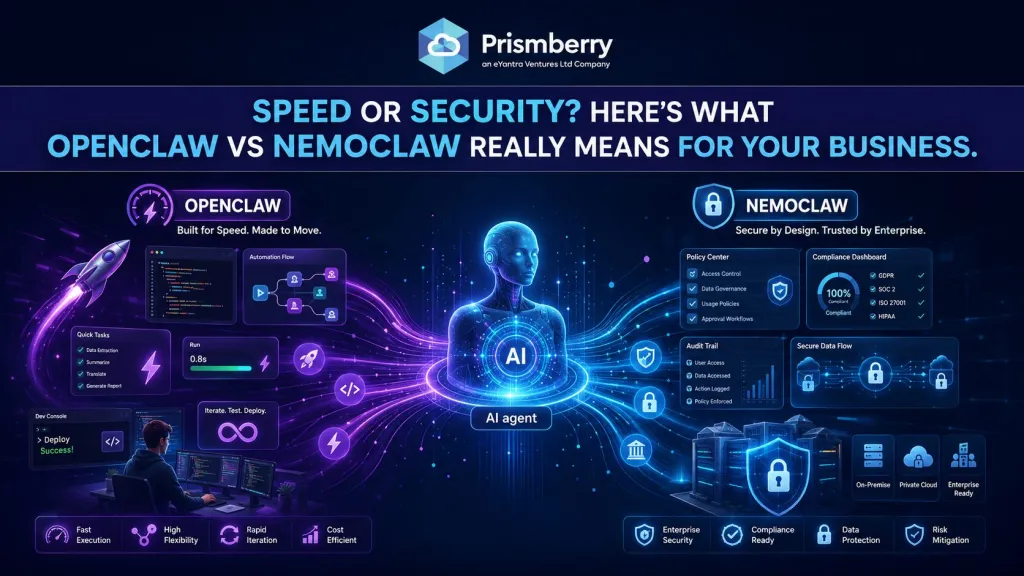
That’s the promise behind OpenClaw and NemoClaw two powerful AI-agent platforms redefining automation. But while they may sound similar, they’re built for very different users and outcomes.
So, which one is right for you?
Let’s break it down.
Understanding the Foundations
Before diving into comparisons, it’s important to understand what each platform fundamentally represents.
OpenClaw: Revolutionising the AI Assistant
OpenClaw is an open-source, on-premise AI assistant that extends automation to various aspects of your digital life – email, calendar, code, web browsing and more – via chat-based tools.
It acts like a “second brain” that doesn’t just respond, it executes.
Key highlights:
- Local (your device, no data sharing)
- Supports messaging apps (WhatsApp, Telegram, Slack)
- Supports various LLMs (GPT, Claude, local)
- Memory for context
- Supports plugins and skills
It’s essentially an AI operating system for individuals and developers.
NemoClaw: Enterprise-Ready AI Agents
NVIDIA’s NemoClaw is based on OpenClaw – but it adds enterprise security.
It containerises OpenClaw with NVIDIA’s OpenShell to provide a sandboxed environment with tight controls around data, network access, and runtime execution.
Key highlights:
- Sandboxed containerized AI agents
- Policy-based security (network, files, processes)
- Native Nemotron AI models
- Enterprise-grade 24/7 operations
- Audit logs and enterprise-friendly design
In simple terms, NemoClaw is OpenClaw with guardrails for enterprises.
Architecture: Flexibility vs. Control
OpenClaw Architecture
OpenClaw is a gateway model:
- Chat platforms connect via a gateway
- AI “brain” uses LLMs to process tasks
- “Hands” (tools/plugins) do work
- Memory is stored in Markdown
This design prioritizes:
Simplicity
Speed
Flexibility
NemoClaw Architecture
NemoClaw adds a secure wrapper layer:
- Isolates OpenClaw within Docker sandbox
- Isolates using OpenShell
- Imposes tight policies (network, file)
- Controls AI inferences
This design prioritizes:
Security
Compliance
Controlled Execution
Feature Comparison
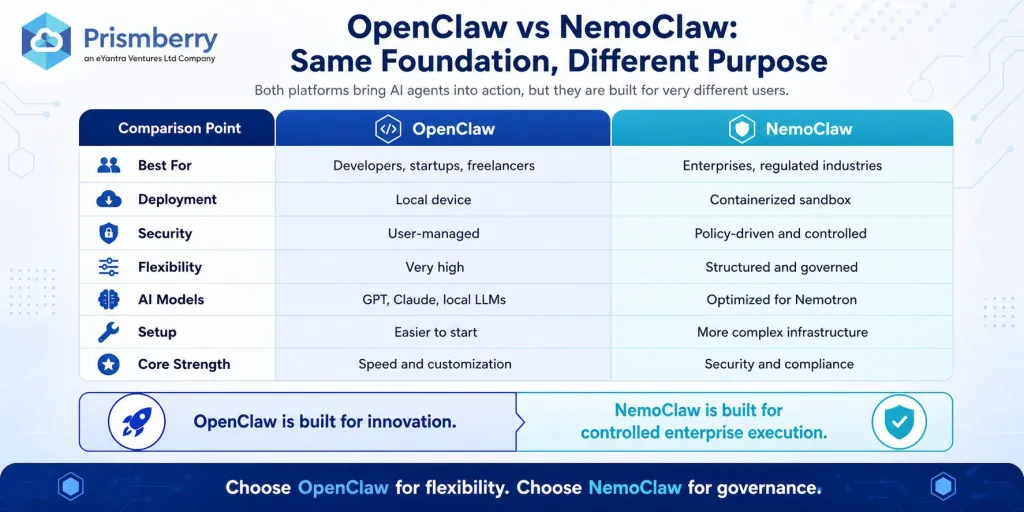
| Feature | OpenClaw | NemoClaw |
| Core Purpose | Personal AI assistant | Enterprise AI agent platform |
| Deployment | Local device | Containerized sandbox |
| Security | Basic (user-managed) | Advanced (policy-driven) |
| Ease of Use | High | Moderate to complex |
| Customization | Extremely flexible | Structured & controlled |
| Hardware Needs | Minimal | Requires stronger infra |
| AI Models | Any (GPT, Claude, local) | Optimized for Nemotron |
| Use Case | Individuals, startups | Enterprises, regulated industries |
Use Cases: Who Should Use What?
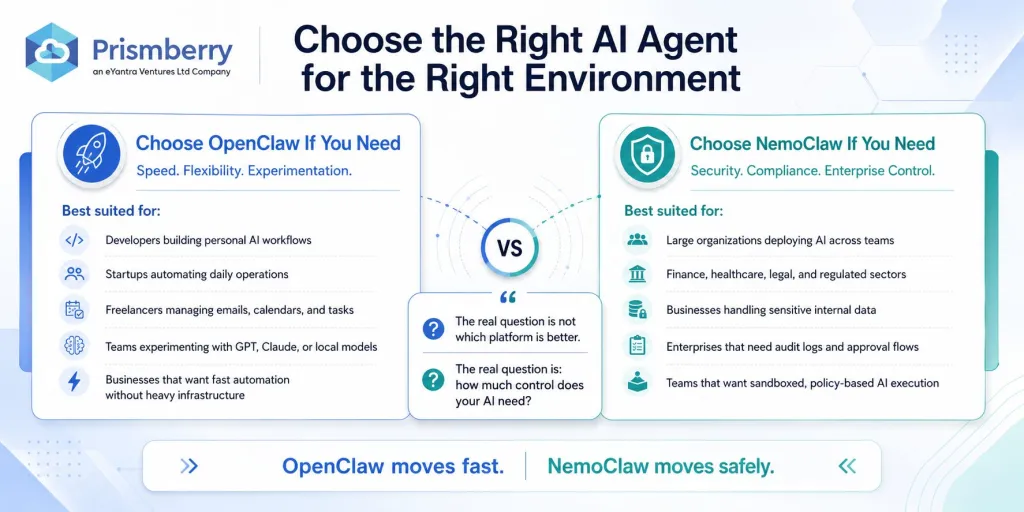
Choose OpenClaw if you are:
- A developer or tech enthusiast
- A startup founder automating workflows
- A freelancer managing multiple tools
- Someone who values flexibility and speed
Example use cases:
- Automating email replies
- Scheduling via WhatsApp
- Coding assistance
- Social media automation
OpenClaw thrives in innovation-driven environments.
Choose NemoClaw if you are:
- A large organization or enterprise
- Handling sensitive or regulated data
- Deploying AI across teams
- Concerned about compliance and security
Example use cases:
- Internal AI assistants for employees
- Secure customer support automation
- AI-driven analytics on private data
- Enterprise workflow automation
NemoClaw is built for trust, governance, and scale.
Security: The Real Differentiator
This is where the biggest gap exists.
OpenClaw Risks
- Requires broad system access
- Vulnerable to prompt injection
- Third-party plugins may pose risks
- No built-in sandboxing
While powerful, it assumes you manage your own security.
NemoClaw Advantages
- Multi-layer isolation (network, filesystem, processes)
- Default-deny policies
- Human approval for risky actions
- Audit logs for traceability
It’s designed for zero-trust environments.
Community & Growth
OpenClaw
- Explosive growth (hundreds of thousands of GitHub stars)
- Massive developer community
- Rapid innovation cycle
- Rich ecosystem of plugins
NemoClaw
- Backed by NVIDIA
- Smaller but focused community
- Enterprise-driven roadmap
- Early-stage (alpha)
Pros and Cons
OpenClaw
Pros:
- Easy to start
- Highly customizable
- Massive community
- Works across platforms
Cons:
- Security risks
- Complex configurations at scale
- Not enterprise-ready
NemoClaw
Pros:
- Enterprise-grade security
- Structured deployment
- Built-in AI infrastructure
- Compliance-friendly
Cons:
- Higher setup complexity
- Hardware requirements
Still evolving
Final Verdict: Which One Wins?
There’s no universal winner, only the right fit.
- Want speed, flexibility, and innovation? → Go with OpenClaw
- Need security, compliance, and scalability? → Choose NemoClaw
Think of it like this:
OpenClaw is your personal AI genius.
NemoClaw is your enterprise AI system with rules.
Closing Thought
AI is no longer about answers; it’s about actions.
And platforms like OpenClaw and NemoClaw are leading that shift.
The question is not if you’ll adopt AI agents,
It’s how securely and effectively you’ll do it.
FAQ’s
OpenClaw is an open-source AI assistant for individuals, developers, and startups, enabling quick automation across email, calendars, messaging apps, and coding tools. NemoClaw, developed by NVIDIA, is an enterprise version of OpenClaw that offers security features like sandboxed containerization, audit logs, and compliance controls for organizations handling sensitive data.
OpenClaw can be used for business, but poses security risks due to broad system access and a lack of sandboxing. Users must manage their own security. For strict compliance needs, NemoClaw offers a more secure alternative with its zero-trust architecture and multi-layer isolation.
NemoClaw is the right choice for enterprises, regulated industries (such as healthcare, finance, or legal), and organizations that need to deploy AI at scale across teams while maintaining strict data governance. It is ideal when you need audit trails, human approval for sensitive actions, default-deny security policies, and NVIDIA’s Nemotron-optimized AI infrastructure.
Yes. One of OpenClaw’s biggest advantages is its model flexibility. It supports a wide range of large language models, including GPT, Claude, and locally hosted models, giving users full control over which AI brain powers their workflows. NemoClaw, by contrast, is primarily optimized for NVIDIA’s native Nemotron AI models, though it is built on the OpenClaw foundation.
OpenClaw is lightweight and designed to run on minimal hardware, making it accessible for individual users and small teams. NemoClaw, however, requires significantly stronger infrastructure due to its containerized Docker sandbox environment and enterprise-grade processing needs. It is best suited for organizations that already have or can provision robust compute resources.
As of the latest information covered in this blog, NemoClaw is still in its early stages (alpha phase). While it is backed by NVIDIA and has a clear enterprise roadmap, it is actively evolving. Organizations considering NemoClaw should factor in the platform’s maturity when planning enterprise deployments, and may want to monitor its development cycle before committing to full-scale adoption.