
How Businesses Can Master AI Integration: Strategies from India’s Tech Vanguard
The global AI market is projected to reach $2.74 trillion by 2032, yet 63% of initiatives fail during pilot stages due to poor integration planning. In India, where the AI sector grows at 40% CAGR toward an $8B market, companies like Bosch, HCL Technologies, and Zensar Technologies demonstrate how strategic AI adoption drives 45% cost reductions and 30% revenue growth. Let’s cut through the hype and examine actionable frameworks for seamless AI assimilation into your operational DNA.
Why AI Integration Fails? And How to Succeed
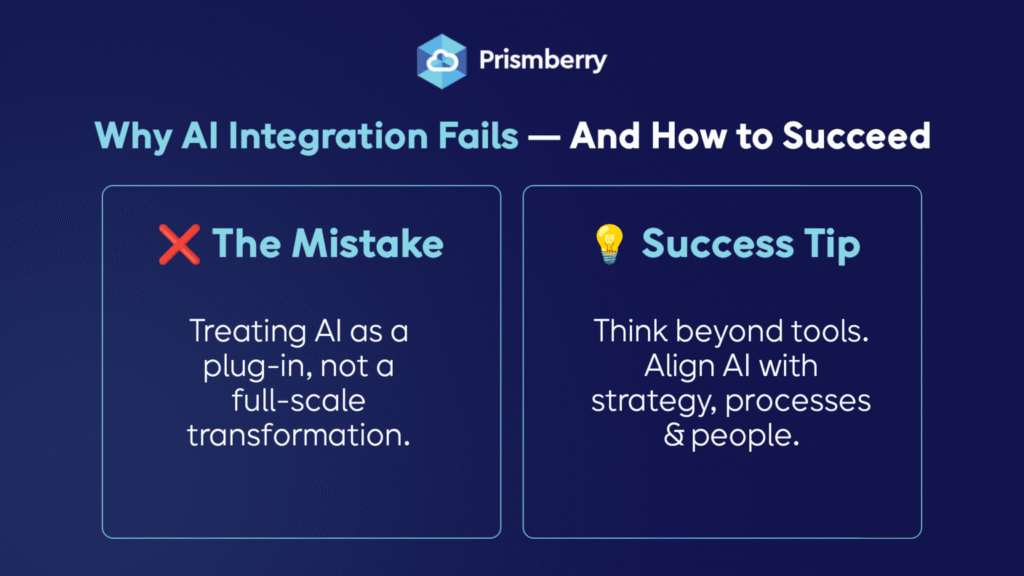
Most businesses stumble by treating AI as a plug-in solution rather than an operational overhaul. Consider these data-backed imperatives:
- Operational Efficiency: AI automates 60-70% of repetitive tasks, liberating human capital for innovation.
- Decision Velocity: Companies using AI analytics report 59% faster insights for strategic pivots.
- Competitive Edge: Indian SMEs adopting AI grew 2.1x faster than peers during the 2023-24 economic shifts.
The key is to view AI as a collaborative teammate, not a tool.
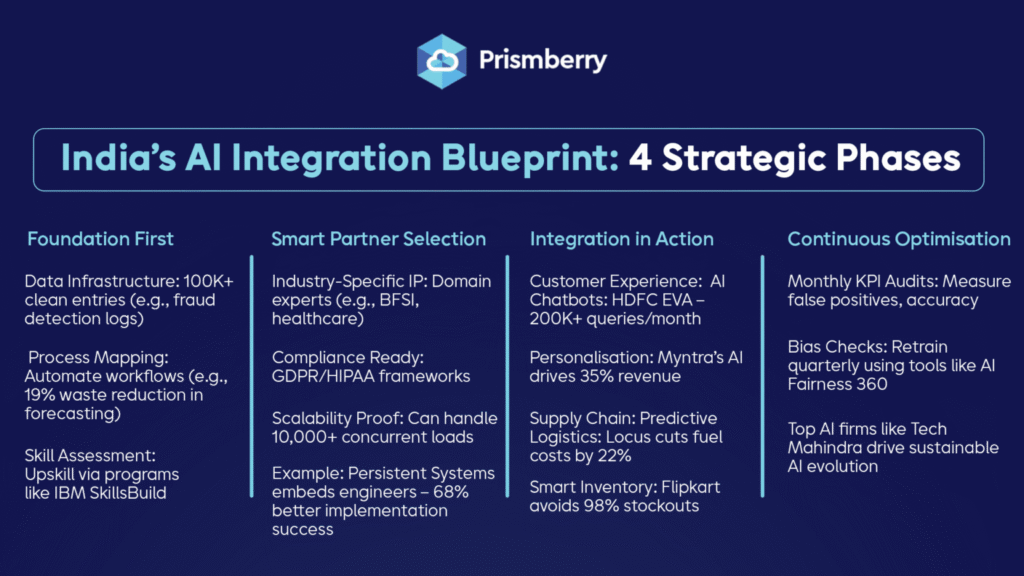
India’s AI Integration Blueprint: 4 Strategic Phases
Phase 1: Foundation First
Before selecting an AI company in India, audit the three core pillars:
- Data Infrastructure: Clean, structured datasets exceeding 100,000 entries (e.g., transaction logs for fraud detection)
- Process Mapping: Identify automation-ready workflows, i.e. inventory forecasting, that reduces waste by 19% in manufacturing.
- Skill Assessment: Upskill teams via programs like IBM’s Skills Build before deployment.
Pro Tip: Start with low-risk pilots. A Pune machinery manufacturer tested predictive maintenance on 3 machines before plant-wide rollout, cutting downtime by 40% in 90 days.
Phase 2: Partner Selection Criteria
Not all the best AI companies in India offer equal value. Prioritise partners with:
- Industry-Specific IP: Banking? Seek fraud detection expertise like Oracle Financial Services Software.
- Compliance Mastery: GDPR/HIPAA-ready frameworks for healthcare or fintech use cases.
- Scalability Proof: Demand evidence of handling 10,000+ concurrent requests during peak loads.
Leading top AI company in India, firms like Persistent Systems embed engineers within client teams to co-develop solutions, a model boosting implementation success rates by 68%.
Phase 3: Integration Workflows
Customer Experience Transformation
- AI Chatbots: HDFC Bank’s EVA handles 200,000+ queries monthly, slashing response times from 8 hours to 2 minutes.
- Hyper-Personalisation: Myntra’s recommendation engine (built with Tata Elxsi) drives 35% of revenue via customised styling feeds.
Supply Chain Revolution
- Predictive Logistics: Locus uses geo-tracking AI to optimise delivery routes, reducing fuel costs by 22%.
- Smart Inventory: Flipkart’s AI demand forecasting achieves 98% stockout avoidance during festive sales.
Phase 4: Continuous Optimisation
Post-launch, top AI companies in India, partners as Tech Mahindra, conduct:
- Monthly KPI Audits: Track ROI via metrics like false-positive rates (fraud systems) or prediction accuracy (demand models)
- Bias Mitigation: Retrain models quarterly using tools like AI Fairness 360 to prevent discriminatory outputs.
The India Advantage: Why Local AI Partners Win
India’s best AI company in the Indian ecosystem delivers unique value:
- Cost Efficiency: Solutions at 30-50% lower cost vs. Western counterparts without compromising quality; a key reason 60% of EU firms outsource AI to India.
- Domain Mastery: Zensar Technologies specialises in agriculture AI for soil analysis, while Intello Labs digitises food quality assessments.
- Scalability Benchmarks: Infosys processes 4.7 billion AI transactions daily across banking clients.
When a Nagpur agritech startup partnered with ai company in India Kellton, they achieved 300% yield growth via AI-powered irrigation scheduling which is a proof that specialized local expertise accelerates ROI.
Future-Proofing Your AI Investment
Emerging Shifts
- Generative AI: Wipro’s Lab45 creates synthetic data to simulate supply chain disruptions, enabling proactive planning.
- Edge Computing: Processing data onsite (e.g., factory floor sensors) cuts latency by 90% for real-time decisions.
- Regulatory Tech: RBI-compliant AI audit trails developed by AI companies in India, leaders like Tata Consultancy Services.
Sustainability Integration
Bosch’s Bangalore AI center reduced plant energy use by 34% via machine learning-driven consumption models all while aligning efficiency with ESG goals.
The Strategic Imperative
Integrating AI isn’t about replacing humans; rather, it’s about augmenting potential. As Karim Lakhani (Harvard Business School) states: “The future of business is AI-powered”. Indian enterprises leveraging top AI companies in India, partners achieve 50% faster implementation cycles and 3x innovation output.
The question isn’t if you should integrate AI, but how soon. With India’s tech vanguard offering world-class expertise at disruptive costs, delaying adoption cedes irrecoverable ground to competitors.
Wrapping It Up
There’s no “loser” here. Only context. React Native is your agile partner for cross-platform dreams, saving time and budget without sacrificing quality. Swift app development is the artisan’s choice for unmatched iOS experiences, where every pixel and interaction feels destined for an Apple device.
Your app’s purpose decides the winner. Validate fast? Go cross-platform. Chase perfection? Go native. Both paths create brilliant apps; they just take different scenic routes.
FAQ
Track three metrics:
1. Operational Gains (e.g., 40% faster processes)
2. Cost Impact (e.g., 30% lower fraud losses)
3. Experience Metrics (e.g., 25-point NPS increase).
Absolutely. Best AI company in India providers like Saksoft offer modular pricing, for e, basic chatbots start at $15,000 with a 6-month ROI.
Address:
1. Data Bias: Use diverse training datasets
2. Skill Gaps: Invest in tools like Machine Hack’s upskilling platform
3. Over-Customisation: Avoid niche solutions lacking upgrade paths.