Picture a 40-person sales team that pays ₹1,500 per user each month for a CRM.
Two of them spend every Friday copying its data into the invoicing system.
Neither cost appeared in the original purchase decision.
Custom software has its own version of this story: a build that ships on time and then has nobody to maintain it.
This guide compares custom vs off-the-shelf software on the figures that sales pages skip, namely three-year cost and what AI changes. It also covers a hybrid route, where you buy the standard software and build only the parts that set you apart.
Whether you plan to hire a custom application development company or renew a licence, it will help you decide.
In this guide, you will discover:
- What each route means and where each one fits
- How to compare cost over three years
- How AI changes the build-or-buy decision
- When a hybrid approach beats both
- A checklist to make the call
Custom vs off-the-shelf software: what the terms mean
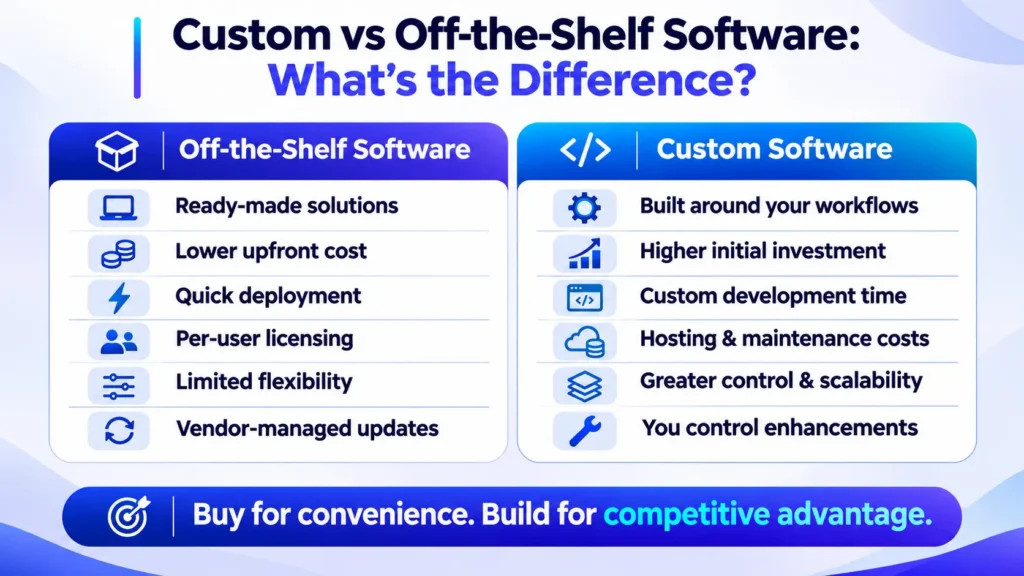
Off-the-shelf software
Ready-made software sold to many customers, usually as a subscription priced per user.
Accounting packages and CRMs are typical examples.
Custom software
Software built for one organisation around its own workflows.
You choose the features and integrations, and you decide where the data lives.
When off-the-shelf software makes sense
- The need is common across companies, such as payroll or accounting
- You need to start within days
- Your process is standard and the software already matches it
- You want the vendor to handle updates and security patches
- The upfront budget is small
Before you sign, read the licence for the annual price-rise limit and for how you can export your data.
A CSV export is not the same as a full copy of your records.
When custom software makes sense
- The workflow is part of how you compete
- Staff re-key data between systems every week
- You need pricing, approval, or scheduling rules the product cannot express
- Per-user licences grow faster than your revenue
- Regulation or customer contracts require control over data
- An AI feature needs your own data and review steps
Custom has its own risks.
Ask who else can maintain the code if the lead developer leaves, and keep the code repository in your own account from day one.
Cost comparison over three years
Where the money goes
| Cost area | Off-the-shelf | Custom |
|---|---|---|
| Upfront | Setup and first licences | Discovery, design, and build |
| Ongoing | Subscription that grows with headcount | Hosting and maintenance |
| Fit to your process | Paid add-ons and workarounds | Built in |
| Integration | Connectors or middleware | Built to your systems |
| Switching later | Data export can be limited | You own the code but carry the upkeep |
A simple three-year formula
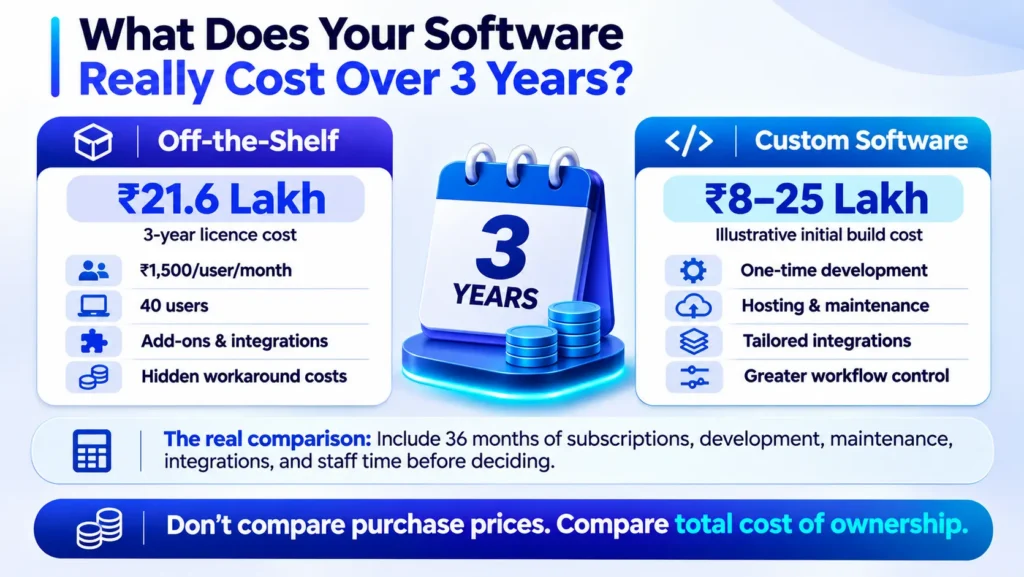
For off-the-shelf software, multiply licences by users and months, then add setup, add-ons, and the staff time lost to workarounds.
For custom software, add the build cost to hosting and maintenance over the same 36 months.
Take the sales team from the opening. ₹1,500 multiplied by 40 users is ₹60,000 a month, or ₹21.6 lakh over three years, before add-ons.
If two people lose four hours every Friday to copying data, that is 416 hours of staff time a year. The figures are illustrative, so replace them with your own.
Agency pricing guides for 2026 put a mid-level custom app at ₹8 lakh to ₹25 lakh before running costs, though the figures vary widely by source.
At 40 users, then, the subscription alone approaches the cost of a mid-level build, and the gap moves as headcount grows.
How AI changes the decision
Off-the-shelf software with built-in AI
Vendors now add AI features to standard products, and switching them on can take minutes.
The trade-off is control. Ask the vendor three questions:
- Can it use your data to train its models?
- Can you see how an output was produced?
- What does the AI add-on cost per user?
Custom AI
A custom build can use your data and your review steps.
It also brings data preparation and accuracy testing, plus a monthly model cost that grows with usage.
A rough test: if AI is central to how you compete, build it. If it only saves time on tasks such as drafting emails, buy it.
The hybrid route: buy the standard software, build the differentiator
A common pattern is to split the work.
- Buy payroll and accounting software
- Build the client portal, pricing logic, or approval workflow that sets you apart
- Connect the two through APIs
- Add custom modules only where a limit costs you real hours
A decision checklist
- Is the process common across companies?
- How many staff hours a week do workarounds cost?
- How many systems must the software connect to?
- What will licences cost over 36 months at your planned headcount?
- Who owns the data, and can you export all of it?
- Do you have the budget and time for a build, plus upkeep afterwards?
- Is AI central to your product or only a convenience?
Yes to the first question points to buying. Yes to most of the rest points to building or a hybrid.
What Prismberry delivers and what sets it apart
Services behind a custom or hybrid build
- Custom software, web, and mobile apps built around your workflows and connected to your existing systems
- AI solutions, including chatbots, enterprise AI agents (its Agent IQ product), generative AI, and machine learning models
- Cloud, DevOps, and QA
- Data analytics
- Staff augmentation, managed services, and support after launch
What sets Prismberry apart
- 120+ AI models in production and 250+ AI specialists, so AI work sits in the same team as the app build
- 500+ solutions delivered across healthcare, banking, e-commerce, and logistics
- One team from discovery to support, which means fewer handoffs
- Offices in Noida and Hyderabad, with a presence in the USA and the Middle East
Conclusion: which route makes better business sense?
How the three routes compare
- Off-the-shelf software gives speed and a low entry cost, but licence growth and workarounds can erode the savings.
- Custom software gives control and a close fit, but needs a larger budget and a named owner for upkeep.
- A hybrid buys the standard software and builds only what differentiates you.
For custom and hybrid builds, a mid-sized agency gives you a full team at a shared cost. Prismberry brings custom development, AI engineering, cloud, QA, and analytics under one roof.
Why clients choose Prismberry
- AI work from the same team that builds the app
- Scope and deliverables defined at every stage
- Security and compliance you can verify
- Support that continues after launch
If you do one thing this week, price your current software over 36 months at your planned headcount and count the workaround hours.
Not sure which route fits your business? Talk to the Prismberry team about your project.
Frequently asked questions
Off-the-shelf software is ready-made and shared by many customers, usually on a per-user subscription. Custom software is built for one organisation around its workflows, so it fits closely but costs more to start and needs ongoing maintenance.
Not always over time. Custom costs more upfront and carries hosting and maintenance, but per-user licences and add-ons can overtake it as a team grows. Compare both over 36 months at your planned headcount, with workaround hours included.
Three signs stand out: staff re-key data between systems, spreadsheets cover gaps the software cannot, and the vendor declines feature requests you need. Licence costs that rise faster than headcount, or a data export that returns only partial records, are further warnings.
Yes. Confirm early that you can export your data and that the software has a documented API. A custom module can then replace one function at a time while the rest keeps running.
If AI is central to how you compete, a custom build lets you use your own data and review steps, but it adds data preparation, accuracy testing, and a monthly model cost. If AI is a convenience, such as drafting emails, the features built into standard software are usually enough.
Off-the-shelf software can start within days. Agency guides for 2026 put simple custom apps at about 8 to 12 weeks and complex ones at 18 weeks or more, depending on scope.