
The Business Model Canvas has long served as a strategic blueprint for organizations to visualize and innovate their business models. However, as artificial intelligence and automation reshape the global business landscape, traditional frameworks require evolution. Enter BMC 2.0, an enhanced approach that integrates AI and automation capabilities directly into business model strategy, enabling organizations to capture unprecedented value while navigating digital transformation.
The Case for Business Model Reimagination
The acceleration of AI adoption has been remarkable. According to recent data, 88 percent of organizations now use AI in at least one business function, up from 78 percent just one year ago. Yet despite this widespread adoption, most companies remain stuck in experimentation mode. Only approximately one-third of organizations have begun to scale their AI programs at the enterprise level. This gap between adoption and value realization underscores a fundamental truth: implementing AI tools is not enough. Organizations must fundamentally rethink their business models.
The economic imperative is clear. Companies using generative AI report an average ROI of $3.7 for every dollar spent, with top performers achieving returns of $10.3 per dollar invested. Furthermore, companies with AI-led processes enjoy 2.5 times higher revenue growth than those without. These statistics reveal that AI is not merely a productivity tool but a strategic differentiator that requires thoughtful integration into core business architecture.
Understanding the Three Layers of AI Integration
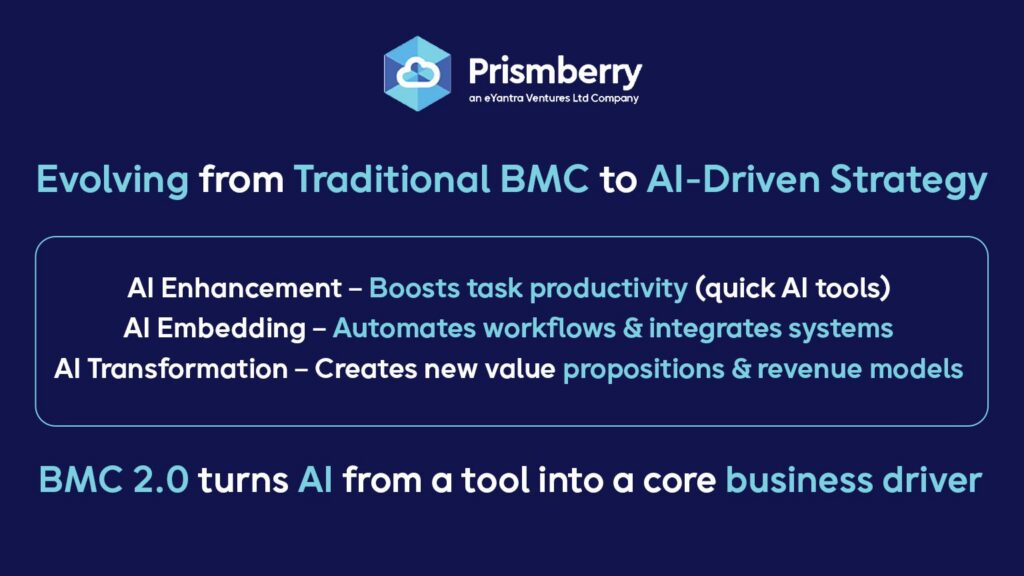
Before reimagining your business model canvas, you must understand where your organization sits on the AI maturity spectrum. AI integration occurs across three distinct layers, each requiring different investment levels and organizational capabilities.
Layer One: AI Enhancement represents the entry point where teams use AI tools like ChatGPT to write emails, create content, or generate reports. The business model remains unchanged, but productivity increases by 10 to 20 percent on specific tasks. Investment remains modest, typically ranging from $50 to $500 monthly in subscriptions with minimal training requirements.
Layer Two: AI Embedding marks a significant leap where AI becomes integrated into workflows through process automation and tool integration. This level requires investments between $5,000 and $50,000 for integration plus substantial training costs. Organizations may experience an initial productivity dip of 19 to 60 percent before realizing full value in 12 to 24 months. At this stage, certain roles shift, and some processes disappear entirely.
Layer Three: AI Transformation represents the most ambitious level, where AI enables entirely new value propositions and fundamentally changes the business model canvas. Investment typically ranges from $50,000 to $500,000 or more, following the well-established 10-20-70 model: 10 percent for algorithms, 20 percent for technology and data, and 70 percent for people and processes. While the potential ROI ranges from 100 to 400 percent, the failure rate remains high at 87 to 95 percent without proper implementation.
Redefining the Nine Building Blocks for the AI Era
BMC 2.0 requires rethinking each of the traditional nine building blocks through an AI-augmented lens. This reimagination process goes beyond simply adding “AI” to existing components; it demands a fundamental reconsideration of how value is created, delivered, and captured.
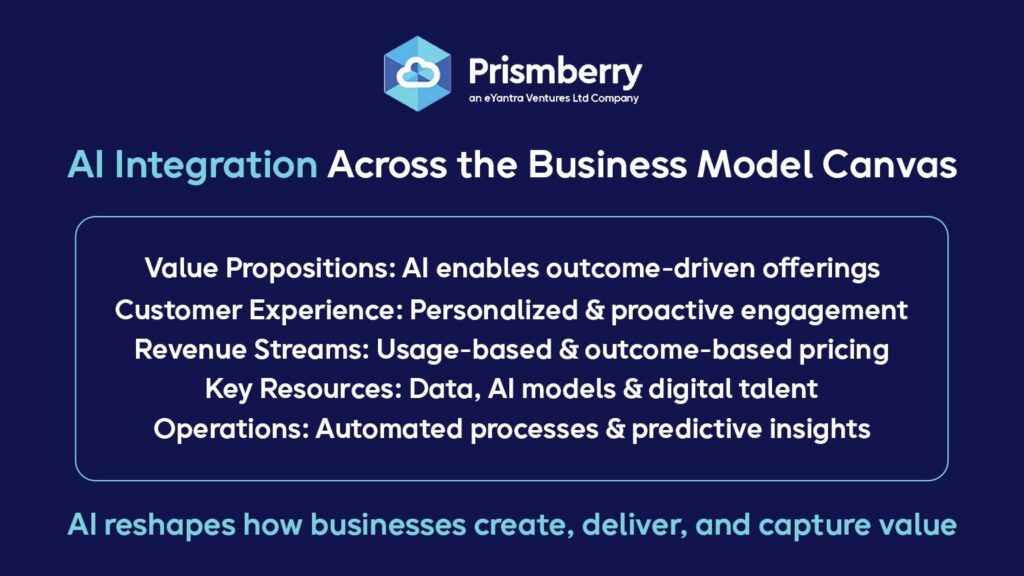
Value Propositions must evolve from discrete offerings to AI-enabled continuous value delivery. Rather than asking “What can we promise customers?”, organizations should ask “What outcomes become achievable with AI that weren’t before?” McKinsey research shows that companies achieving 20 to 40 percent conversion rate improvements in customer service through AI automation are those that have fundamentally redefined their value propositions.
Customer Segments expand dramatically when AI automation reduces service costs. The transformation approach focuses on reaching customer segments that were previously too expensive to serve. For example, an accounting firm might launch an AI-powered micro-business CFO service targeting sole traders and small businesses who could never afford traditional CFO advice, thereby addressing entirely new addressable markets.
Channels shift from enhancing existing distribution methods to creating entirely new AI-enabled channels. Digital platforms, API integrations, and enterprise partnerships take center stage. Organizations must consider how AI agents can automate routine interactions while maintaining high-quality customer experiences across all touchpoints.
Customer Relationships transform from transactional interactions to continuous engagement powered by AI. Rather than responding to support tickets, AI enables proactive relationship management through predictive analytics and personalized recommendations. Companies must design tiered engagement models ranging from self-service onboarding to high-touch strategic partnerships.
Revenue Streams diversify as AI capabilities unlock new monetization models. Beyond traditional licensing fees and subscriptions, organizations can implement usage-based billing, outcome-based pricing, and platform fees. The key lies in aligning pricing models with the value AI creates for customers rather than merely automating existing revenue mechanisms.
Key Resources increasingly center on data infrastructure, AI models, and technical talent. Organizations must invest in robust data platforms, computing infrastructure, and specialized AI capabilities. However, the most critical resource remains organizational capacity for continuous learning and adaptation.
Key Activities expand to include model training, data curation, algorithm optimization, and continuous AI system monitoring. Automation streamlines routine operations, including scheduling, logistics, and data entry, while enhancing decision-making through predictive models and real-time dashboards. Companies must balance automation efficiency with strategic human oversight.
Key Partnerships evolve to encompass AI platform providers, data suppliers, and technology integrators. Strategic alliances with cloud providers like Google Cloud Platform become essential for scaling AI capabilities. Organizations must also consider partnerships that provide access to proprietary datasets or specialized AI expertise.
Cost Structure undergoes a fundamental transformation as fixed technology costs replace variable labor expenses. Initial implementation costs remain substantial, but automation delivers long-term cost reductions between 10 and 50 percent by automating repetitive tasks and minimizing manual errors. Organizations must plan for ongoing investments in model maintenance, data quality, and talent development.
The High Performer Advantage: What Separates Leaders from Laggards
Research reveals stark differences between organizations that generate significant value from AI and those that struggle. AI high performers, defined as companies attributing at least 5 percent of their EBIT to AI, share several critical characteristics.
First, they demonstrate transformative ambition. While 80 percent of companies treat AI as an efficiency tool, high performers are 3.6 times more likely to use AI to drive radical transformation focused on growth and innovation. Second, they systematically redesign workflows rather than simply automating existing processes. Approximately 55 percent of high performers fundamentally rework processes when deploying AI, nearly three times the rate of other firms.
Third, high performers benefit from active leadership commitment. These organizations are three times more likely to report strong commitment from top leadership that consistently and transparently supports AI initiatives. Finally, they make significant financial commitments, with one-third allocating more than 20 percent of their digital budget to AI compared to only 7 percent of other organizations.
Implementation Roadmap: From Canvas to Reality
Transforming your business model canvas to integrate AI and automation requires a structured approach that balances ambition with pragmatism. Begin by conducting a comprehensive assessment of your current business model across all nine building blocks. Identify processes that consume significant resources, customer pain points that remain unaddressed, and opportunities where AI could enable entirely new capabilities.
Next, prioritize high-impact use cases that align with strategic objectives. Focus on areas where AI can deliver measurable business outcomes within reasonable timeframes. Resist the temptation to pursue numerous small pilots; instead, concentrate resources on 3 to 5 transformative initiatives that can achieve enterprise-wide scale.
Invest heavily in organizational readiness, remembering the 10-20-70 principle. While algorithms and technology matter, 70 percent of success depends on people and processes. This means comprehensive upskilling programs, change management initiatives, and cultural transformation to embrace AI-first thinking throughout the organization.
Establish robust governance frameworks from the outset. As McKinsey research shows, 28 percent of AI-using organizations report that their CEO is responsible for overseeing AI governance. Clear accountability, well-defined KPIs, and systematic risk mitigation protocols form the foundation for sustainable AI integration.
Finally, embrace iterative refinement. The Business Model Canvas was designed for continuous evolution, and BMC 2.0 amplifies this principle. Regular reviews, A/B testing of AI-enhanced features, and continuous feedback loops ensure your business model remains responsive to market dynamics and technological advancements.
Conclusion: The Future Belongs to AI-Native Business Models
The integration of AI and automation into business model strategy represents more than incremental improvement. It marks a fundamental shift in how organizations create, deliver, and capture value. BMC 2.0 provides the framework for navigating this transformation, but success ultimately depends on organizational courage to reimagine possibilities.
The statistics speak clearly: AI adoption has reached mainstream levels at 88 percent, yet value realization remains elusive for most. The companies that will thrive in the coming decade are those willing to move beyond surface-level implementation to embrace deep structural transformation. They will redesign workflows, reallocate resources, develop new capabilities, and fundamentally rethink their business models through an AI-augmented lens.
The question facing business leaders today is not whether to integrate AI into their business models, but how quickly and comprehensively they can execute this integration. Those who embrace BMC 2.0 thinking now position themselves to lead their industries. Those who delay risk irrelevance in an increasingly AI-native business landscape.