
The world of Artificial Intelligence is experiencing rapid evolution, and with this speed comes a dizzying array of terminology. Terms like “Generative AI,” “AI Agents,” and “Agentic AI” are often used interchangeably in business discussions, leading to misunderstandings that can derail digital transformation projects.
However, these three terms represent distinct levels of complexity, autonomy, and capability. Confusing them can lead to selecting the wrong tools or services for a business problem. For companies investing heavily in their digital future, securing the right kind of artificial intelligence development services starts with understanding this key separation.
This article provides a necessary clarification, defining the role of each technology, and explaining why the distinction between Agentic AI vs AI Agents vs Generative AI is a critical framework for any business planning its next technological move. We will explore how these components work together, not just in theory, but in the practical, goal-oriented solutions being created by the top AI company in India today.
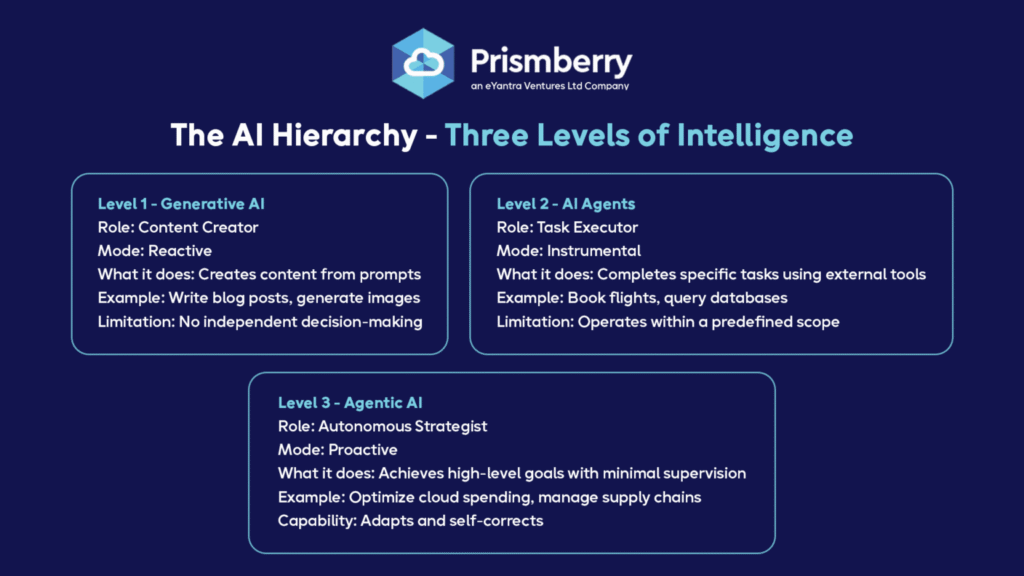
Generative AI: The Content Creator (Reactive)
Generative AI (GenAI) is the AI most people are familiar with today, primarily through tools that produce new content.
What it is
Generative AI refers to models, most famously Large Language Models (LLMs), that are trained on vast datasets to recognise and recreate patterns. Its primary function is creation in response to a direct, specific prompt.
Core Function
GenAI is inherently reactive. It waits for a specific instruction, such as “Write a blog post about marketing trends” or “Generate an image of a red sunset”, and delivers a corresponding output. It does not independently decide why the content should be created or what steps should follow that creation. It has no “memory” or connection to the outside world beyond its training data, unless specifically augmented by a human-designed input loop.
Business Use Case
Generating text drafts, synthesising research summaries, writing initial lines of code, or creating marketing visuals. It serves as a powerful, instant drafting and content tool.
AI Agents: The Task-Executor (Instrumental)
An AI Agent is where the technology starts to move into the real world. It bridges the gap between the static outputs of Generative AI and real-world actions.
What it is
An AI Agent is a system that uses an LLM (or another reasoning engine) as its “brain” and connects it to external tools and APIs. The agent’s goal is to accomplish a defined, specific objective that requires interaction with external software or data.
Core Function
An AI Agent is instrumental. It takes a human-defined task (e.g., “Find the cheapest flight from Mumbai to London for next month”) and breaks it into steps that involve using external tools. The key components include:
- A Reasoning Engine (LLM): Interprets the request and decides which tool to use next.
- Tools: Connections to APIs (e.g., a flight booking system, a CRM, a database).
- Memory: Stores the immediate context of the current task.
The agent executes the defined task by accessing these tools. While it takes action, it still operates within a predefined scope set by a human manager, and it typically does not re-plan the overall strategy if circumstances drastically change.
Business Use Case
Automated customer service bots that can look up an order status in a database, intelligent search features that query the internet for real-time data, or systems that automate data entry across two different software platforms.
Agentic AI: The Autonomous Strategist
Agentic AI represents the highest level of current AI capability, building directly upon the foundational reasoning of Generative AI and the tool-using capability of AI Agents.
What it is
Agentic AI is an intelligent, complex, and autonomous system composed of one or more AI Agents working collaboratively or individually toward a high-level, persistent goal with minimal human supervision. Agentic AI is the overarching framework or concept, while AI Agents are the individual, task-executing building blocks within that framework.
Core Function
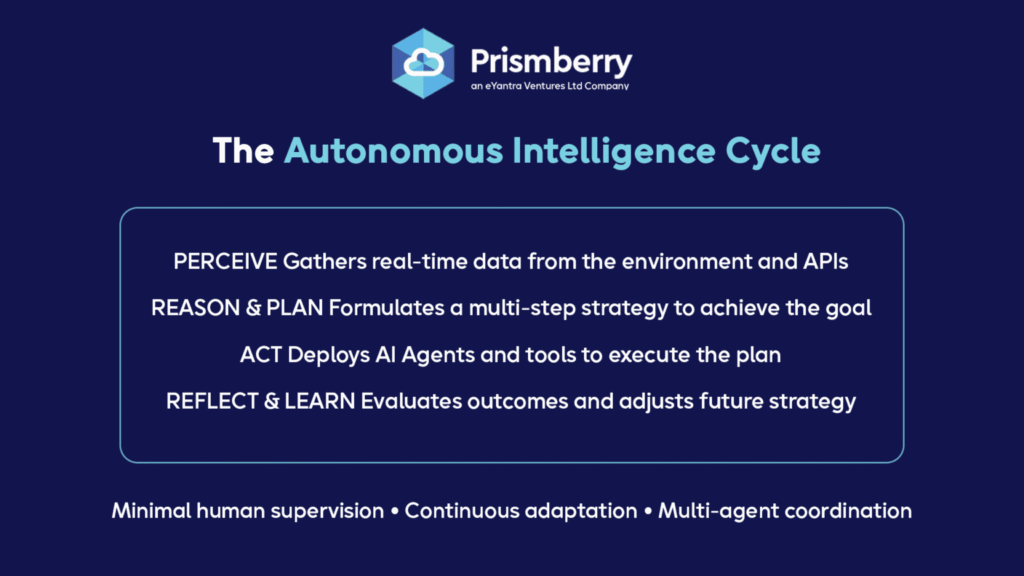
Agentic AI is fundamentally proactive. It doesn’t wait for step-by-step instructions. Instead, it is given an objective (e.g., “Reduce our quarterly cloud spending by 15%”), and the system autonomously performs a multi-step loop:
- Perceive: Gathers real-time data from the environment (e.g., current cloud usage APIs).
- Reason/Plan: Formulates a multi-step plan (e.g., identify unused resources, schedule them for deletion, write a report justifying the change).
- Act: Uses its internal AI Agents and their tools (e.g., sends API calls to delete resources, invokes a GenAI model to write the justification report).
- Reflect/Learn: Evaluates the outcome and adjusts its strategy for future actions.
The Agentic system can adapt its plan when facing obstacles and can coordinate multiple specialised agents (e.g., a planning agent working with a coding agent and a database agent) to resolve complex issues.
Business Use Case
Autonomous financial planners that constantly monitor market data and execute trades based on user risk profiles, self-correcting supply chain systems that automatically reroute shipments when facing a port delay, or sophisticated software testing systems that debug and self-heal code.
The Integration Edge: Why India Leads in Agentic Solutions
The shift in focus from content generation (GenAI) to autonomous action (Agentic AI) is changing how businesses select their development partners. It’s no longer about who can generate the best text, but who can architect and deploy the most reliable, secure, and adaptable autonomous workflows.
This is where the deep expertise of the top AI company in India becomes a critical advantage. Indian firms have years of experience in system integration, enterprise-level software development, and building complex, mission-critical digital transformation projects for global clients. Agentic AI is, at its core, a sophisticated form of automation and systems integration backed by powerful LLMs.
Businesses require artificial intelligence development services that can smoothly integrate a GenAI reasoning core with existing proprietary tools, APIs, and legacy databases. The capacity to orchestrate complex, multi-agent workflows, all while managing security, compliance, and enterprise scalability, is a specialisation that Indian technology providers have honed through decades of servicing large international corporations. This ability to deliver integrated, goal-oriented solutions is positioning them at the forefront of the Agentic AI revolution.
Conclusion: A Spectrum of Capability
The most effective AI strategy does not pick one technology over the others; it orchestrates them. Generative AI provides the intelligence, AI Agents provide the functional action, and Agentic AI provides the strategic autonomy. By understanding Agentic AI vs AI Agents vs Generative AI, business leaders gain the clarity needed to commission the precise digital systems that will drive true operational leverage in the years ahead. The future belongs to those who can build these interconnected, intelligent ecosystems.
FAQ’s
No. Simple projects (like content drafting) only need Generative AI. Complex projects (like autonomous cloud cost management) need all three: Generative AI for reasoning, AI Agents for tool execution, and Agentic AI for strategic, multi-step planning.
A Generative AI model acts as the “brain” or reasoning engine inside an AI Agent. The Agent is the surrounding framework that provides the model with external tools (APIs) and memory, allowing it to take real-world actions.
Agentic AI has the highest risk profile because of its autonomy. Since it is designed to take actions and make decisions without constant human oversight, careful controls, continuous monitoring, and strict boundaries must be built into the system from the start.