The Subscription Product That Does More Than Store Data
Building a SaaS product used to mean dashboards, workflows, user accounts, and recurring billing.
What if a subscription product can:
“Review this customer account, identify the risk, recommend the next action, write the response, and update the CRM.”
And it just happens.
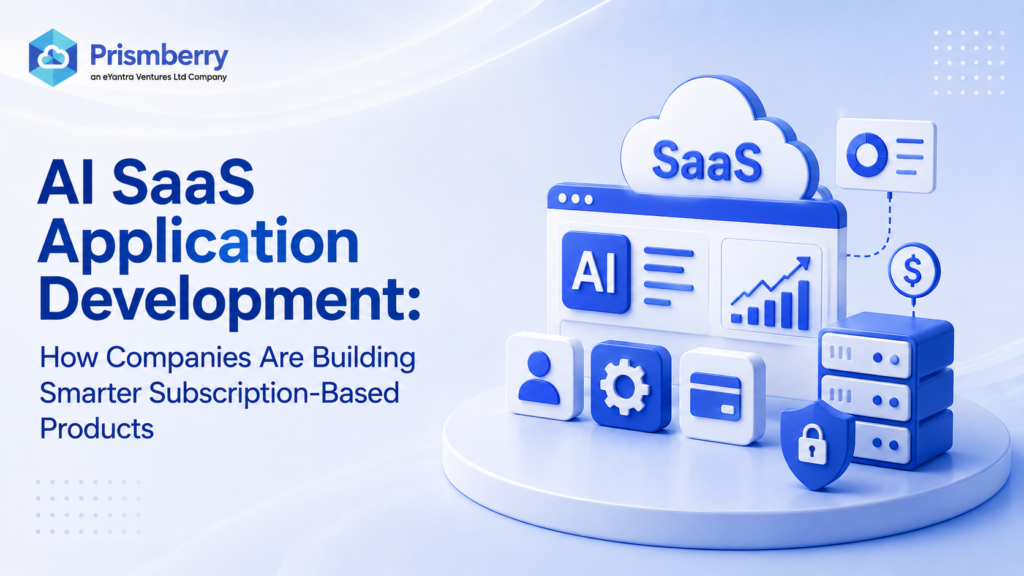
That is the shift behind AI SaaS application development.
Companies are building products that understand context, predict outcomes, and complete work.
But adding a chatbot does not automatically create an AI SaaS product. The platform still needs secure multi-tenant architecture, usage tracking, billing logic, data isolation, and an experience customers will keep paying for.
So how are companies building smarter subscription-based products?
Let us break it down.
Why Subscription Software Is Getting Smarter
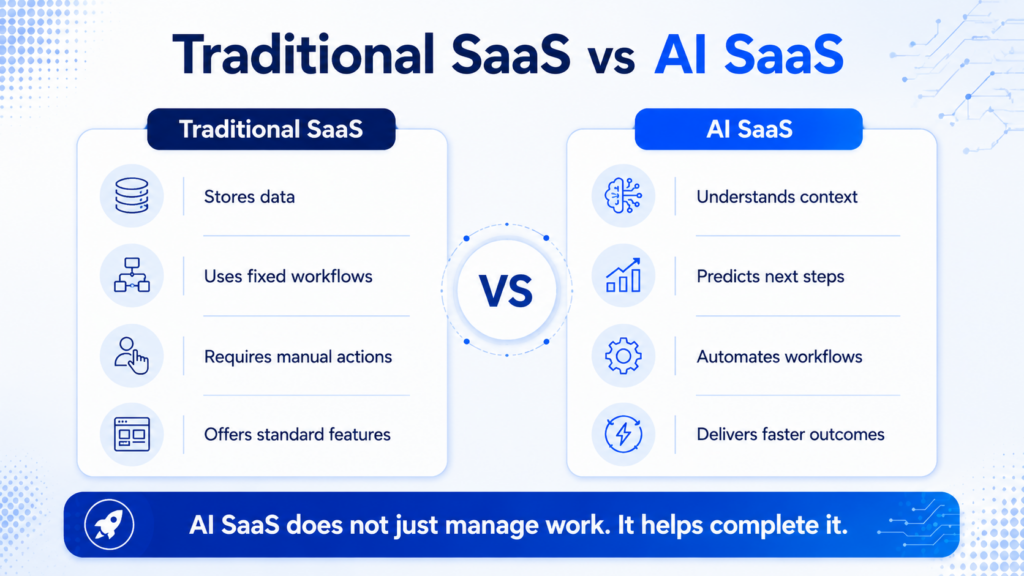
Traditional SaaS helps user’s complete tasks.
AI SaaS helps users decide what to do next.
A traditional sales platform stores leads. An AI-powered platform can identify the strongest opportunity, draft the follow-up, and trigger the next workflow.
A traditional support tool organizes tickets. An AI support product can understand the issue, search company knowledge, and prepare a response.
What customers now expect:
- Fewer manual steps
- Personalized recommendations
- Natural language interaction
- Faster decisions
- Automation across connected tools
In short: subscription software is moving from systems people operate to systems that actively help people work.
What Makes an AI SaaS Product Different
AI SaaS application development is not traditional SaaS development with a model API added at the end.
The intelligence must work within the product’s permissions, data boundaries, pricing model, and customer experience.
Traditional SaaS vs AI SaaS Products
| Aspect | Traditional SaaS | AI SaaS Product |
| Interaction | Menus, forms, dashboards | Conversation, recommendations, actions |
| Core Logic | Fixed rules and workflows | Models, context, adaptive workflows |
| Data Use | Store, filter, and report | Retrieve, interpret, generate, predict |
| Customer Value | Access to software features | Faster outcomes and less manual work |
| Pricing | Seats or feature tiers | Seats, usage, outcomes, or hybrid pricing |
| Improvement | Product releases | Releases plus model improvement |
The difference is not that one product has AI.
The difference is that intelligence becomes part of how the subscription delivers value.
How Companies Are Building Smarter Subscription-Based Products
Here is where things get interesting.
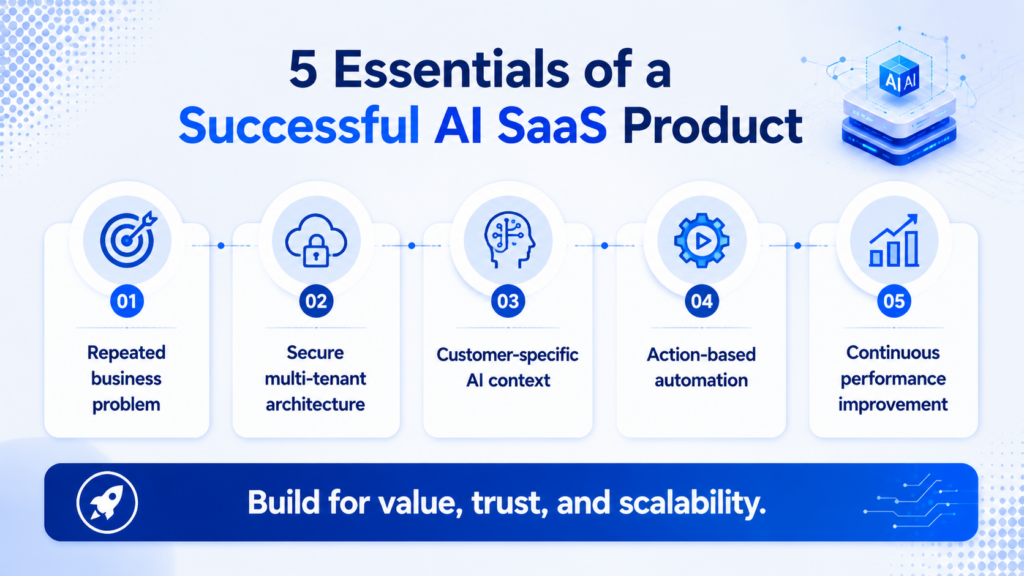
1. They Start with a Repeated Business Problem
The strongest AI SaaS products do not begin with, “Where can we add AI?”
They begin with a task users repeat every day, such as reviewing documents, qualifying leads, or creating reports.
A repeated problem creates repeated value. Repeated value creates subscription potential.
That is why successful AI SaaS application development starts with workflow discovery before model selection.
2. They Build Multi-Tenant Intelligence
A subscription platform must serve many customers without mixing identities, data, permissions, or AI context.
The system must know the user’s organization, permissions, configuration, and measured usage.
Some products use shared models with isolated data. Others provide dedicated environments.
The right choice depends on security, cost, performance, and customer expectations.
3. They Give AI the Right Business Context
Generic model knowledge is rarely enough for a valuable SaaS product.
The AI needs customer-specific information such as policies, account history, documents, or analytics.
This is where retrieval systems, APIs, vector search, and permission-aware data pipelines become important.
The goal is to provide the right information, for the right tenant, at the right moment.
4. They Move from Answers to Actions
A smart subscription product should not stop at generating text.
The real value appears when the product can update a record, create a task, send a notification, generate a document, or move a workflow forward.
A finance product can explain a variance and prepare the follow-up. A recruiting platform can rank candidates and schedule the next step.
This action layer turns an AI feature into a product customers depend on.
5. They Design Pricing Around Usage and Value
AI changes SaaS economics.
Every request can create model, retrieval, storage, and infrastructure costs. A flat price may become risky when one customer generates far more AI activity than another.
Companies are responding with:
- Seat-based subscriptions with AI limits
- Tiered plans with monthly credits
- Usage-based pricing for tasks, documents, minutes, or tokens
- Hybrid pricing with a base subscription and overages
- Enterprise contracts with committed capacity
The best model is easy for the customer to understand and safe for the provider to scale.
6. They Engineer for Reliability, Not Just Demos
An AI demo can look excellent with carefully selected prompts.
A subscription product must work for thousands of unpredictable requests.
That means AI application development services must account for latency, failed model calls, hallucinations, prompt injection, provider outages, cost spikes, and model changes.
Production systems use validation, fallback models, rate limits, approval steps, audit logs, and monitoring.
Trust becomes part of the product experience.
7. They Build a Continuous Improvement Loop
Traditional SaaS teams monitor conversions, retention, and feature adoption.
AI SaaS teams also monitor response quality, retrieval accuracy, task completion, model cost, latency, and user corrections.
The best products turn this feedback into better prompts, better retrieval, better automation, and better outcomes.
The AI SaaS Models Companies Are Launching
- AI Copilot: Assists users inside an existing workflow, saving time and improving decisions.
- Vertical AI Platform: Solves a specialized industry problem with domain-specific intelligence.
- Agentic Workflow SaaS: Completes multi-step tasks across tools and reduces operational effort.
- AI Analytics Product: Explains data, predicts outcomes, and speeds up decisions.
- Generative Operations Platform: Produces reports, content, or documents at greater scale.
The winning model depends on the workflow and the value the product repeatedly delivers.
The Real Challenge: Scaling Trust, Not Just Features
AI SaaS application development creates opportunities, but it also creates responsibilities.
Customer data must remain isolated. Model access must respect permissions. Generated outputs must be traceable. Usage needs to be visible. Costs must remain controlled. Sensitive actions need approval.
When the AI lacks context, it should ask. When a decision has meaningful consequences, the workflow should involve a person.
The smartest product is not the one that automates everything.
It is the one that knows what to automate, what to explain, and when to stop.
How Prismberry Builds AI SaaS Products
Choosing a model is only one part of the journey.
Building the subscription architecture, AI workflows, tenant isolation, billing logic, interfaces, and monitoring is where the real product work begins.
Prismberry provides AI application development services for companies building intelligent SaaS products. We help teams define the use case, design the architecture, connect business data, integrate models, and prepare the platform for secure scaling.
The focus is on creating a product customers use, trust, and renew.
Whether you are building a vertical AI platform, enterprise copilot, automation product, or new subscription business, Prismberry’s AI application development services help turn the idea into a practical and scalable product.
Final Thoughts: The Best SaaS Product Does More Than Store Work
Subscription products became successful because they made software accessible, continuously updated, and easy to adopt.
AI is creating the next shift.
The new generation of SaaS products will not only store, display, or organize work.
They will help complete it.
Success will come from solving a repeated problem, building a trustworthy architecture, pricing the intelligence clearly, and improving the product around customer outcomes.
The question is not:
“Should we add AI to our SaaS product?”
The real question is:
What valuable work should our subscription product start doing for the customer?
Frequently Asked Questions
A: AI SaaS application development is the process of building subscription software in which artificial intelligence is part of the core experience. It combines multi-tenancy, user management, billing, and continuous delivery with generation, prediction, retrieval, personalization, and workflow automation.
A: A chatbot may be one interface, but a true AI SaaS platform connects intelligence with customer data, permissions, workflows, and actions. It can use tenant-specific context, complete tasks, measure usage, and improve the core job the customer is paying for.
A: Most products need a multi-tenant application layer, secure identity controls, tenant-aware data storage, model integrations, retrieval systems, usage metering, subscription billing, monitoring, and guardrails.
A: Pricing should reflect customer value while protecting the provider from unpredictable AI costs. Common approaches include subscriptions with usage limits, monthly credit systems, usage-based charges, and hybrid plans.
A: Professional AI application development services help companies avoid mistakes in architecture, tenant isolation, model selection, workflow design, cost control, and monitoring. An experienced team can connect the AI layer with the subscription product so it is secure, maintainable, and ready to scale.