
Your Model Is Not the First Thing You Need
Your team has selected a promising machine learning model. The data looks useful. Leadership wants results quickly.
Then the problems start.
The dataset takes hours to load. GPU capacity is unavailable. Experiments cannot be reproduced. The model performs well in testing, but the production endpoint slows down when real users arrive.
The model was not necessarily the problem.
The infrastructure around it was never ready.
That is why AI infrastructure for machine learning must be planned before businesses begin expensive training runs or deploy models into customer-facing systems.
Let us break it down.
The Hidden Gap Between an AI Demo and a Business System
AI demos can look deceptively simple.
A data scientist can run one successful notebook experiment and make the business feel close to launch. But production needs reliable data pipelines, suitable compute, fast storage, orchestration, version control, monitoring, security, and a clear way to scale. Without that foundation, releases slow down, predictions become unstable, and cloud costs rise.
What AI Infrastructure for Machine Learning Actually Includes
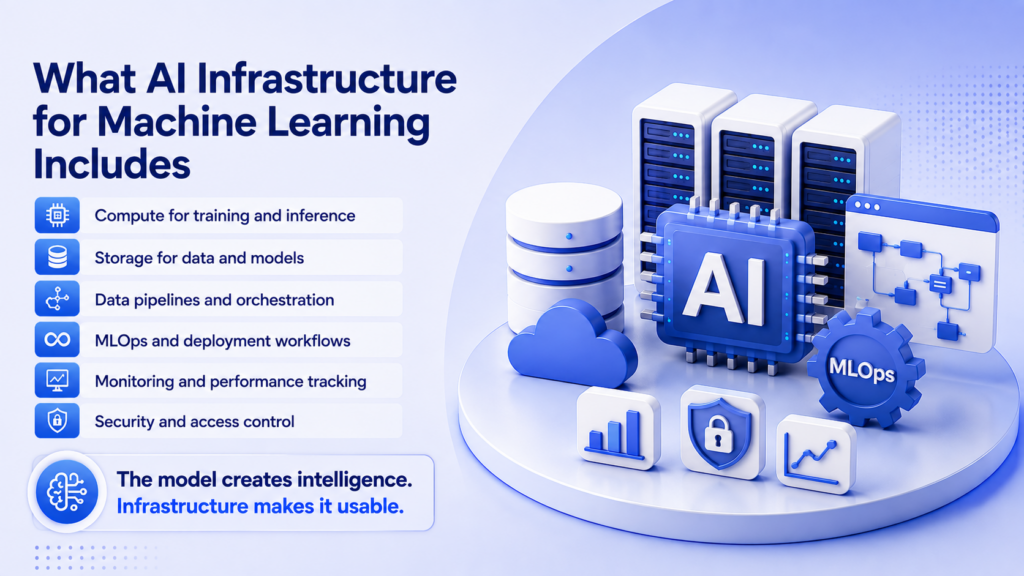
AI infrastructure for machine learning is the complete technology environment used to prepare data, train models, deploy them, monitor their behaviour, and improve them over time.
It usually includes:
- Compute resources such as CPUs, GPUs, and specialised accelerators
- Storage for datasets, features, models, and experiment outputs
- Networking between compute, storage, and production systems
- Data pipelines for collecting, cleaning, and transforming information
- Containers and orchestration tools for repeatable workloads
- Model registries, experiment tracking, and deployment pipelines
- Monitoring for model quality, latency, infrastructure, and cost
- Security controls for data, models, users, and endpoints
In simple terms: the model creates intelligence, but infrastructure makes that intelligence usable and reliable.
Training Infrastructure vs Deployment Infrastructure
Businesses often treat training and deployment as one infrastructure problem. They are not.
Training is compute intensive and usually runs in batches. Deployment, also called inference, must respond consistently to users, applications, or business systems.
| Area | Training Infrastructure | Deployment Infrastructure |
| Main purpose | Build and improve models | Serve predictions reliably |
| Workload pattern | Heavy batch processing | Continuous or request based |
| Scaling need | Temporary compute bursts | Traffic driven capacity |
| Performance focus | Training speed and throughput | Latency and availability |
| Failure response | Restart or resume jobs | Failover without user disruption |
The Right Data Foundation Comes First
Machine learning models depend on the data they receive.
Before training, businesses must know where data lives, who owns it, whether it is complete, and whether it can be used securely. Cleaning, validation, transformation, and versioning must be repeatable. Otherwise, results may be impossible to reproduce and deployed models may lose accuracy without warning.
Choose Compute, Storage, and Networking Together
More compute does not automatically mean better infrastructure.
A traditional prediction model may run efficiently on CPUs. Computer vision, deep learning, and large language model workloads may require GPUs. Some jobs need multiple accelerators, while smaller models may need only one instance.
Businesses should evaluate model size, dataset volume, training frequency, response time, traffic, and budget before selecting hardware. Storage and networking matter just as much because slow data access can leave expensive GPUs waiting and increase training time.
Build Repeatable Environments, Not One Time Setups
A model that runs only on one engineer’s machine is not ready for business use.
Teams need consistent environments across development, testing, training, and production. Containers package dependencies, while orchestration platforms schedule workloads and recover failed jobs. Repeatability makes results easier to reproduce as data, models, frameworks, and teams change.
MLOps Must Be Planned Before Production
Traditional software pipelines manage code releases. Machine learning pipelines must manage code, data, features, experiments, model versions, and performance.
A good MLOps foundation tracks experiments, validates models, automates deployment, supports safe rollbacks, and records which data and settings produced each result. Manual processes may work for one model but usually break as usage grows.
Monitoring Starts Before Go Live
A model can remain online while becoming less useful.
Infrastructure monitoring tracks resources, failures, and latency. Model monitoring tracks prediction quality and drift. Business monitoring links those signals to outcomes. These controls should be designed before deployment so teams know when action is required.
Security and Governance Cannot Be Added Later
Machine learning systems may process customer records, financial information, intellectual property, or regulated data.
Businesses need access controls, encryption, network isolation, audit logs, secrets management, and clear approval processes. These controls protect sensitive information and create traceability across the model lifecycle.
Plan for Cost Before Scaling
AI costs can rise quietly.
Training jobs may leave expensive instances running. Deployment endpoints may be oversized. Poor scheduling can leave accelerators idle while another team waits for capacity.
Businesses should track spending by workload, model, team, and environment. Autoscaling, scheduling, limits, and dashboards help connect infrastructure spending to business value. Good AI infrastructure services make cost visible before it becomes a surprise.
What Businesses Should Decide Before Training
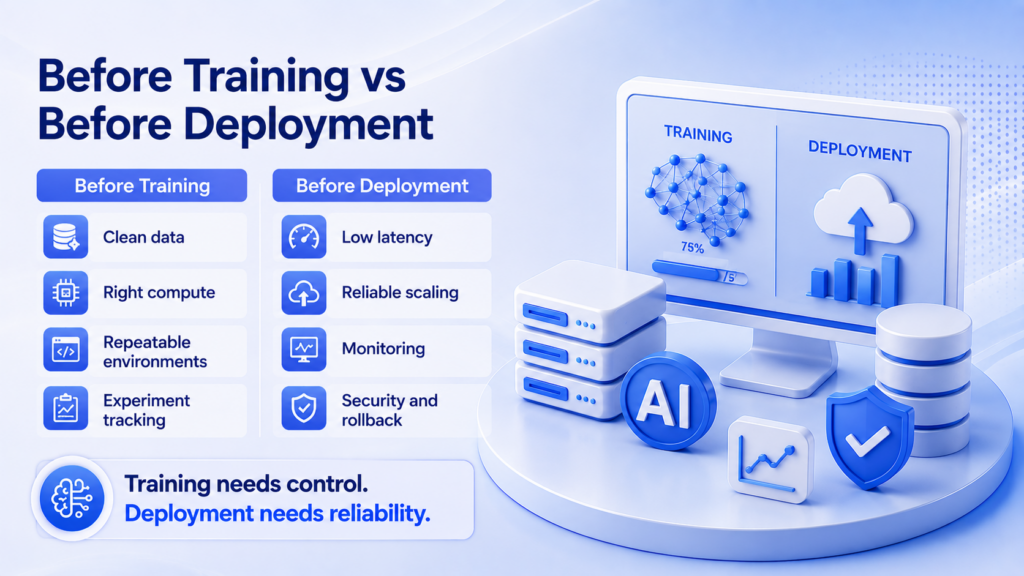
Before starting model training, businesses should answer:
- What business outcome will the model improve?
- Is the data complete, approved, and versioned?
- Which compute type fits the workload?
- How will experiments be tracked and reproduced?
- Who can access the data and environment?
- How will the model be evaluated before release?
These decisions prevent teams from spending heavily on experiments that cannot move into production.
What Businesses Should Decide Before Deployment
Before a model goes live, the questions change:
- How quickly must it respond?
- How many requests must the system support?
- What happens if the endpoint fails?
- How will capacity scale during traffic spikes?
- Which model and infrastructure metrics will be monitored?
- How will updates and rollbacks work?
- What security controls are required?
Deployment infrastructure should be designed around reliability and user experience, not only model accuracy.
Where AI Infrastructure Services Make the Difference
Building this foundation requires cloud, data engineering, GPU, DevOps, MLOps, security, and cost expertise. AI infrastructure services close internal skill gaps by designing the environment, automating operations, and supporting the move from experiments to production. They are especially valuable for first deployments, legacy modernisation, multi model scaling, and regulated workloads.
How Prismberry Helps Businesses Prepare for Production AI
At Prismberry, we help businesses build the infrastructure foundation required to train, deploy, and scale machine learning systems with confidence.
Our AI infrastructure services cover workload assessment, cloud and GPU architecture, data pipelines, containerised environments, MLOps automation, deployment, monitoring, security, and optimisation. We start with the business use case, then design an environment that supports the model, users, and future growth.
Final Thoughts: Build the Foundation Before the Model Depends on It
Machine learning success does not begin with pressing the train button.
It begins with trusted data, compute that fits the workload, repeatable systems, and production infrastructure that can be monitored and secured.
AI infrastructure for machine learning determines whether a promising model becomes a reliable business system or remains an expensive experiment.
Before training, businesses need control and reproducibility. Before deployment, they need reliability, security, and scale.
The companies that prepare both sides early will move faster, spend more intelligently, and avoid rebuilding the foundation after users are already waiting.
Frequently Asked Questions
AI infrastructure for machine learning combines compute, storage, networking, data pipelines, orchestration, MLOps tools, monitoring, and security systems. It provides the technical foundation required to train models, deploy them reliably, and improve them after launch.
Before training, businesses need approved data, suitable compute, dependable storage and networking, reproducible environments, experiment tracking, access controls, and clear evaluation criteria. The exact setup depends on the workload and budget.
Yes. Training usually requires powerful compute for temporary batch workloads. Deployment infrastructure must provide stable, low latency predictions for users and applications. Training focuses on throughput and experimentation, while deployment focuses on availability, response time, scaling, and reliability.
A business should consider AI infrastructure services when internal teams lack cloud, GPU, MLOps, or security expertise, or when existing systems cannot support production workloads. They help reduce risk, control cost, and scale across teams.
Prismberry assesses workloads, designs AI architecture, prepares data and compute environments, automates pipelines, deploys endpoints, and implements monitoring and security for current and future AI workloads.