
Imagine spending months developing an application. The design looks impressive, the features work during demonstrations, and everyone is excited about the launch.
But once real users start interacting with it, problems appear.
The application is difficult to navigate. Important features are missing. Development costs keep increasing. Eventually, the product fails to deliver the expected business value.
This happens more often than businesses realise.
A McKinsey study with the University of Oxford found that large IT projects exceeded their budgets by an average of 45% and delivered 56% less value than predicted.
So, why do application development projects fail, even when businesses invest significant time and resources?
From my experience in the technology industry, the problem often begins long before developers start writing code.
Unclear expectations, poor planning, and overlooked user requirements can turn promising ideas into expensive mistakes.
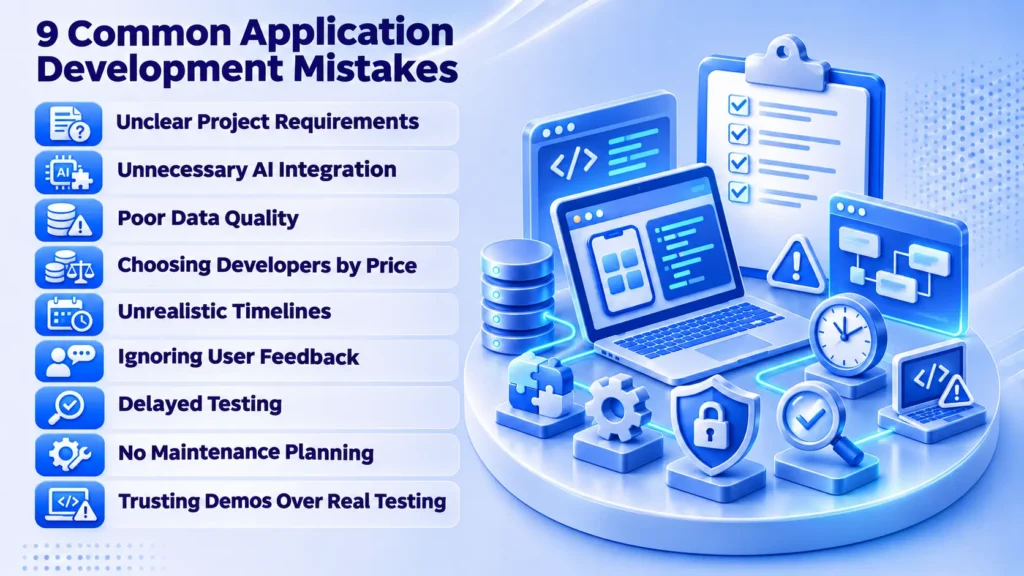
Let’s explore nine common application development mistakes and how businesses can avoid them.
Why Do Application Development Projects Fail?
Application development projects rarely fail because of a single technical problem.
Most failures result from several small decisions made throughout the development lifecycle.
For example, a business may start with unclear requirements, select a development partner based entirely on pricing, and postpone testing until the final stage.
Individually, these decisions may seem manageable. Together, they can affect the project’s timeline, budget, quality, and success.
The most common causes include:
- Unclear project requirements
- Unrealistic development timelines
- Poor data quality
- Limited user involvement
- Inadequate quality assurance
- Lack of post-launch planning
Understanding these risks early helps businesses make more informed development decisions.
1. Starting Development Without Clear Requirements
“We’ll figure out the details as we go.”
This statement might sound flexible, but it can create serious problems during application development.
When project requirements are unclear, business stakeholders, designers, and developers may have completely different expectations.
For example, a business might request a customer management application without defining essential workflows, integrations, or user permissions.
The result? Missing features, repeated modifications, and unexpected costs.
How can businesses avoid this mistake?
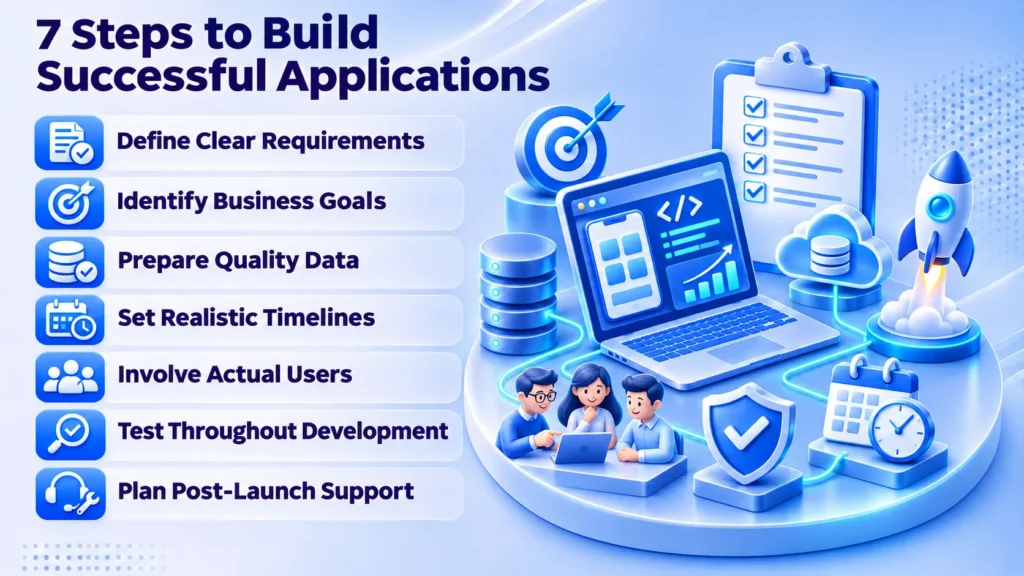
Start with a documented project scope that explains:
- What problem the application will solve
- Who will use the application
- Which features are essential
- How project success will be measured
Clear requirements create a common understanding before development begins.
2. Adding AI Without Understanding Its Purpose
Artificial intelligence is transforming application development, but not every application needs AI.
Some businesses introduce chatbots, recommendation engines, or automation simply because competitors are doing the same.
However, adding AI without a meaningful use case can increase development complexity without improving the product.
RAND’s 2024 research identified prioritising technology over real business problems as a major contributor to AI project failure.
What should businesses do instead?
Before implementing AI, ask:
- What specific problem will AI solve?
- Can the same task be completed without AI?
- What measurable improvement should the feature deliver?
For instance, an AI chatbot designed to answer recurring customer questions has a clearer purpose than a chatbot added only to make an application appear innovative.
Technology should support business objectives, not define them.
3. Ignoring Data Quality Before Development
An application is only as reliable as the information supporting it.
This becomes particularly important when developing applications involving artificial intelligence, analytics, or business automation.
Businesses often assume that because data exists, it is ready to use.
However, information may be outdated, incomplete, duplicated, or stored across disconnected systems.
Imagine developing an AI-powered recommendation system using inaccurate customer information. Even an advanced algorithm may generate irrelevant recommendations.
How can this be prevented?
Before development, review the available data.
Check its accuracy, accessibility, ownership, security, and suitability for the intended functionality.
Resolving data-related problems early can prevent significant complications during implementation.
4. Choosing Developers Based Only on the Lowest Price
Every business wants to manage its development budget.
However, the cheapest quotation does not always represent the most cost-effective solution.
Some development estimates exclude essential services such as quality assurance, security testing, documentation, or maintenance.
These exclusions may eventually appear as additional expenses.
A project that initially looks affordable can become significantly more expensive when repeated modifications and delays are involved.
What should businesses evaluate?
Instead of comparing prices alone, consider:
- The development team’s experience
- Technical expertise and project understanding
- Included services and exclusions
- Project communication and management
- Testing and post-launch support
The objective should be to select a team capable of delivering reliable software within a realistic budget.
5. Setting Unrealistic Application Development Timelines
“We need this application launched in eight weeks.”
A fixed deadline may be necessary for business reasons. But setting one before understanding project complexity creates unnecessary pressure.
Application development involves multiple stages, including planning, design, coding, integration, testing, and deployment.
Rushing these activities can result in incomplete functionality or compromised quality.
How can businesses manage timelines better?
Start by estimating the development effort.
Break the project into achievable milestones and prioritise features according to business importance.
When time is limited, consider launching a Minimum Viable Product (MVP).
An MVP allows businesses to introduce essential functionality, gather user feedback, and expand gradually.
A smaller, reliable first release is often better than an unfinished application with too many features.
6. Developing Applications Without User Feedback
An application may look excellent to its development team but feel confusing to actual users.
Why?
Because developers and business stakeholders understand how the application is supposed to work.
First-time users do not have that advantage.
Complicated navigation, unnecessary steps, and unclear instructions can discourage users from adopting an application.
How can businesses improve usability?
Involve actual users during the design process.
Create interactive prototypes, observe how users complete important tasks, and identify confusing experiences.
Gather feedback before development and repeat usability testing before launch.
An application should be designed around how people naturally interact with technology, not how its creators expect them to behave.
7. Leaving Application Testing Until the End
Testing is sometimes treated as the final activity before an application goes live.
This is a costly mistake.
When defects are discovered late, fixing them may require changes across several interconnected components.
For example, an integration issue identified during the final week could affect authentication, data processing, and multiple user workflows.
What is the better approach?
Testing should happen throughout development.
Teams should regularly perform:
- Functional testing
- Integration testing
- Performance testing
- Security testing
- User acceptance testing
For AI-powered applications, testing should also evaluate accuracy using realistic examples.
Continuous quality assurance helps identify problems while they are easier to resolve.
8. Forgetting About Application Maintenance
A successful launch does not mean application development is complete.
Applications need regular updates to remain secure, functional, and compatible with changing technology.
Without maintenance, businesses may experience performance issues, outdated integrations, and unresolved vulnerabilities.
AI-powered applications can require additional monitoring because model performance and operational costs may change over time.
How can businesses prepare?
Create a post-launch maintenance plan before deployment.
Define who will manage updates, monitor performance, resolve technical issues, and handle security concerns.
Also establish a realistic maintenance budget.
An application is a long-term digital asset that requires continuous attention.
9. Assuming a Successful Demo Means the Application Is Ready
A product demonstration usually takes place under controlled conditions.
The data is carefully selected, the internet connection works, and the expected user journey is already known.
Real-world conditions are different.
Users may enter unexpected information, operate on older devices, or follow workflows that nobody anticipated.
This is particularly important for AI applications, where results can vary depending on the quality and complexity of inputs.
How can businesses avoid this mistake?
Test applications using realistic scenarios rather than relying entirely on demonstrations.
Consider a limited pilot launch before making the product available to everyone.
Monitor how real users interact with the application, identify unexpected problems, and improve the product before scaling.
Real-world validation provides stronger evidence of readiness than a polished demonstration.
How Can Businesses Recognise a Failing Application Development Project?
Not every struggling project needs to be abandoned.
Sometimes, identifying problems early can help teams recover before costs escalate.
Watch for warning signs such as:
- Project requirements changing repeatedly
- Development milestones being missed
- Budgets increasing without visible progress
- Frequent bugs appearing in completed features
- Poor communication between stakeholders
- No clearly defined success metrics
If these issues appear, review the original objectives and evaluate the application’s current state.
In some situations, reducing the scope or changing development priorities can help bring the project back on track.
How Prismberry Approaches Application Development
At Prismberry Technologies, we believe successful application development begins with understanding what a business actually needs.
Our work spans custom web and mobile applications, application modernisation, AI solutions, cloud services, quality assurance, and ongoing technical support.
We also develop enterprise AI products, including Agent IQ and Revenue IQ, that reflect our focus on practical applications of intelligent technology.
The central principle is simple: technology decisions should be guided by business requirements, user expectations, and long-term maintainability.
For organisations planning an application, asking the right questions early can help prevent avoidable challenges later.
Final Thoughts: Successful Applications Start With Better Decisions
Application development failures rarely happen overnight.
They usually begin with small mistakes that remain unnoticed until the project becomes difficult or expensive to change.
Unclear requirements, unrealistic timelines, insufficient testing, and limited user involvement can affect even promising application ideas.
As Founder and CEO of Prismberry Technologies, one principle I consider particularly important is identifying risks while they are still manageable.
Before investing in a new application, ask whether the problem is clearly defined, the users are understood, and the development approach is realistic.
Because successful application development is not simply about building more features.
It is about building the right solution for the right problem.

Frequently Asked Questions
Unclear requirements are among the most common causes. When project objectives, features, and success metrics are not properly defined, businesses can experience scope changes, delays, and budget overruns.
Businesses can reduce project risks through clear planning, realistic timelines, experienced development teams, continuous testing, user feedback, and structured post-launch maintenance.
Frequent requirement changes, missed deadlines, unexpected costs, unresolved technical problems, and poor stakeholder communication are common warning signs.
Yes, depending on its condition. Businesses can reassess project objectives, review existing code and data, prioritise essential functionality, and revise the development roadmap.
For new products with uncertain requirements or market demand, an MVP can reduce initial risk. It allows businesses to validate essential features with users before investing in full-scale development.