

Search for what an app costs in India, and the answers run from under ₹1 lakh to more than ₹2 crore.
That is not a typo.
The spread is real, and most of the explanation sits in the quote, not in the code.
A ₹5 lakh figure and a ₹50 lakh figure often describe two different products, built by different teams, with different things left out.
Add AI to the app and a second cost appears: the monthly bill for running it.
This guide explains the application development cost in India in 2026, including typical ranges, what moves the price, what AI adds, and how to get a quote you can compare.
In this guide, you will discover:
- Typical cost ranges by app complexity
- The factors that move the price
- What AI adds to build and running costs
- Costs that quotes often leave out
- How to get an accurate, comparable quote
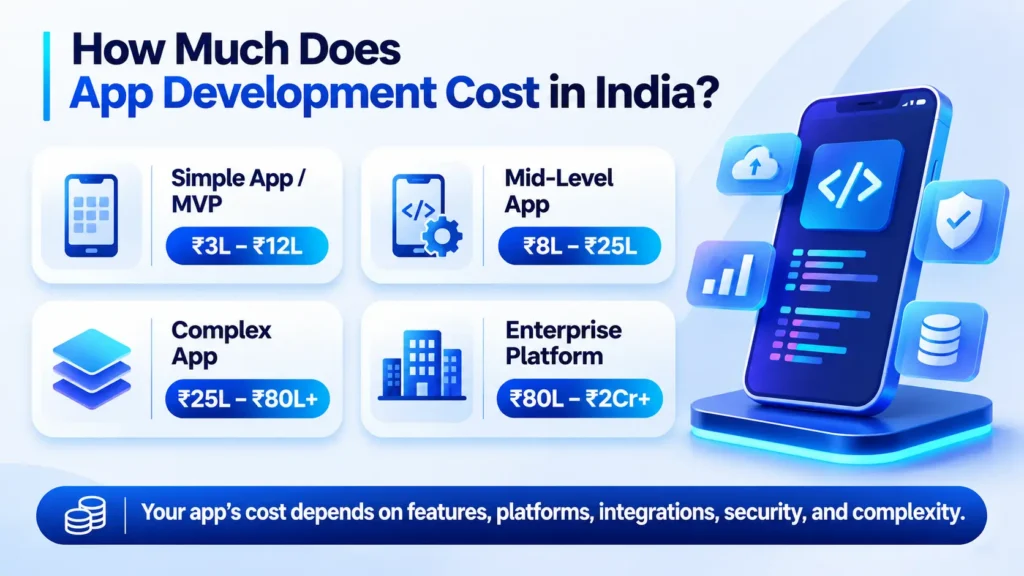
Application development cost in India: typical ranges in 2026
Cost by app complexity
Agency-published guides give overlapping but different figures.
The table below summarises the ranges that recur most often.
| App type | Typical range (INR) | Typical timeline | What it usually covers |
|---|---|---|---|
| Simple app or MVP | ₹3 lakh to ₹12 lakh | 8 to 12 weeks | Login, a few core features, basic design |
| Mid-level app | ₹8 lakh to ₹25 lakh | 12 to 18 weeks | Integrations, payments, an admin panel |
| Complex app | ₹25 lakh to ₹80 lakh or more | 18 to 32 weeks or more | Real-time features, advanced security, many integrations |
| Enterprise platform | ₹80 lakh to ₹2 crore or more | Varies | Multi-system integration, compliance, scale |
Note: These ranges come from agency-published 2026 guides, which differ by source. Treat them as orientation, not a quote.
Hourly rates: India compared with the US and UK
A simple formula sits behind most quotes: hours of work multiplied by the hourly rate.
Published 2026 guides put mobile developers in India at roughly $15 to $70 an hour, with senior engineers often at $25 to $50.
US and UK rates are often quoted at $80 to $200.
A low hourly rate does not always mean a low total.
What drives the price
Product factors
- Scope and number of features
- Platforms: Android, iOS, and web together cost more than one
- Design: custom interfaces and animations take longer than template layouts
- Integrations with payments, CRMs, or older systems
Delivery factors
- Security and compliance needs in sectors such as healthcare and finance
- Team seniority, location, and engagement model
- AI features, covered in the next section
What AI adds to the cost
An AI feature changes the budget in two ways: more work to build, and a running cost after launch.
Extra build costs
- Data preparation: cleaning data and checking that you may use it
- Model or API integration
- Accuracy testing against real examples from your business
- Security work, since data may pass to a model provider
- Monitoring of accuracy and spend after launch
Running costs after launch
Suppose each AI request costs ₹2 and you expect 50,000 requests a month. The model bill is ₹1 lakh a month, before hosting and monitoring.
Those figures are illustrative, but the arithmetic is worth doing with your own numbers.
How to budget: pricing models and hidden costs
Pricing models and your budget
| Model | Effect on your budget |
|---|---|
| Fixed price | Predictable total, but changes mid-project are billed as extras |
| Time and material | Flexible, but costs can drift without close tracking |
| Dedicated team | A fixed monthly cost that suits long-term products |
For AI apps, ask whether model usage sits inside the quote or is billed on top.
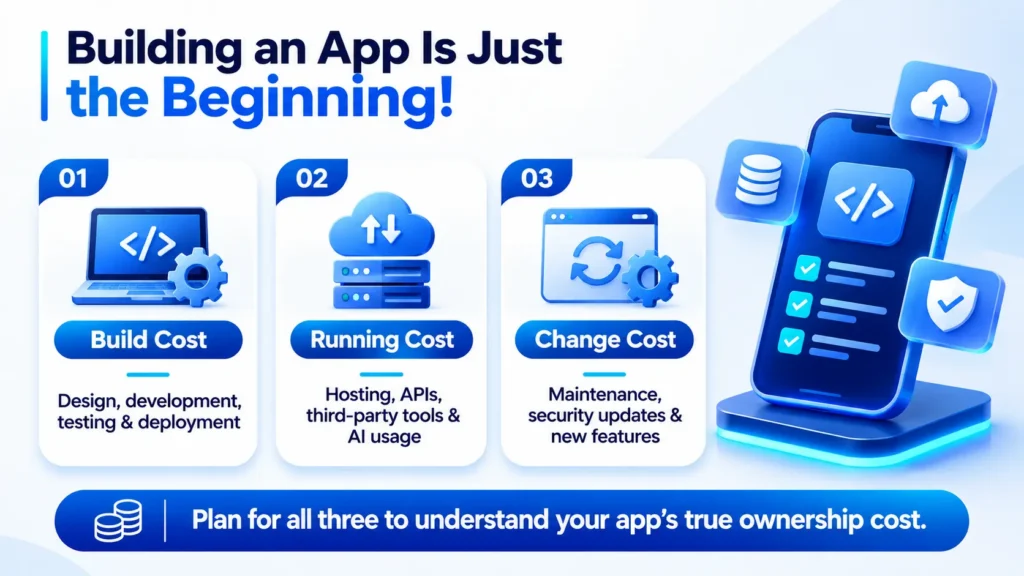
Three budgets, not one
A single build figure hides most of the cost of owning an app.
- Build cost: the one-time price of discovery, design, development, and testing
- Running cost: cloud hosting, third-party services such as maps, SMS, and payment gateways, app store fees, and, for AI apps, model usage
- Change cost: security audits, maintenance, fixes, and new features after launch
Ask each agency for all three, so you can compare the cost of owning the app over a year.
Quotes often leave out the second and third, so ask for maintenance as a monthly or yearly figure.
How to get an accurate, comparable quote
Follow these steps before you compare any two proposals:
- Write a short scope document with your users, features, and platforms.
- Decide what belongs in the first version and what can wait.
- Ask each agency for a line-item estimate with hours and rates.
- Ask what the quote excludes.
- Ask how scope changes are priced.
- For AI features, ask for accuracy results on real examples and an estimate of monthly model cost.
- Tie payments to milestones and deliverables.
What Prismberry delivers and what sets it apart
Services behind these numbers
- Custom software, web, and mobile apps built around your workflows
- AI solutions, including chatbots, enterprise AI agents (its Agent IQ product), generative AI, and machine learning models
- Cloud, DevOps, and QA
- Data analytics
- Staff augmentation, managed services, and support after launch
What sets Prismberry apart
- 120+ AI models in production and 250+ AI specialists, so AI work sits in the same team as the app build
- 500+ solutions delivered across healthcare, banking, e-commerce, and logistics
- One team from discovery to support, which means fewer handoffs
- Offices in Noida and Hyderabad, with a presence in the USA and the Middle East
For your business, this can mean less manual work through automation, faster decisions through analytics, and fewer vendors to manage.
Conclusion: what to budget for application development in India
Your three routes
- An in-house team gives you control, but salaries and hiring time add up, and a team with both app and AI skills is a bigger hire.
- Freelancers can lower the cost of small, well-defined tasks, though one person rarely covers design, QA, security, and support.
- A mid-sized agency gives you a full team across the lifecycle at a shared cost.
Within that last group, Prismberry brings custom development, AI engineering, cloud, QA, and analytics under one roof.
Why clients choose Prismberry
- AI work from the same team that builds the app
- Scope and deliverables defined at every stage
- Security and compliance you can verify
- Support that continues after launch
Want a cost estimate for your project? Talk to the Prismberry team and get a scoped estimate.
Frequently asked questions
Published 2026 guides put simple apps and MVPs at about ₹3 lakh to ₹12 lakh, mid-level apps at ₹8 lakh to ₹25 lakh, and complex apps at ₹25 lakh to ₹80 lakh or more. Scope, platforms, integrations, and team seniority decide where your project falls, so ask for a line-item quote.
It costs more to build than a comparable standard app, because of data preparation, model integration, and accuracy testing. It also adds a running cost that grows with usage: multiply expected monthly requests by the cost per request, then add monitoring. Ask whether model usage sits inside the quote.
Agencies often assume different scope, platforms, design depth, and team seniority, and they exclude different items, such as hosting, testing, and maintenance. A cheap quote may leave out work that returns later as a change request. Ask for line-item estimates and exclusions to compare like with like.
Rarely. A low figure can reflect a junior team, thin testing, or items left out of scope, and rework can then cost more than a fair price at the start. Compare the cost of owning the app over a year, covering build, running, and change costs.
Fixed price suits small, well-defined projects and MVPs, since scope, price, and deadline are set in advance, though changes are usually billed as extras. Time and material or a dedicated team suits an evolving idea or a long-term roadmap, but needs close tracking from your side. Choose by how clear your scope is today.
Launch an MVP first and expand with real user feedback. Write a clear scope before development starts, since mid-project changes add cost. Use a cross-platform framework when one codebase can serve both mobile platforms, and start AI with a single task.