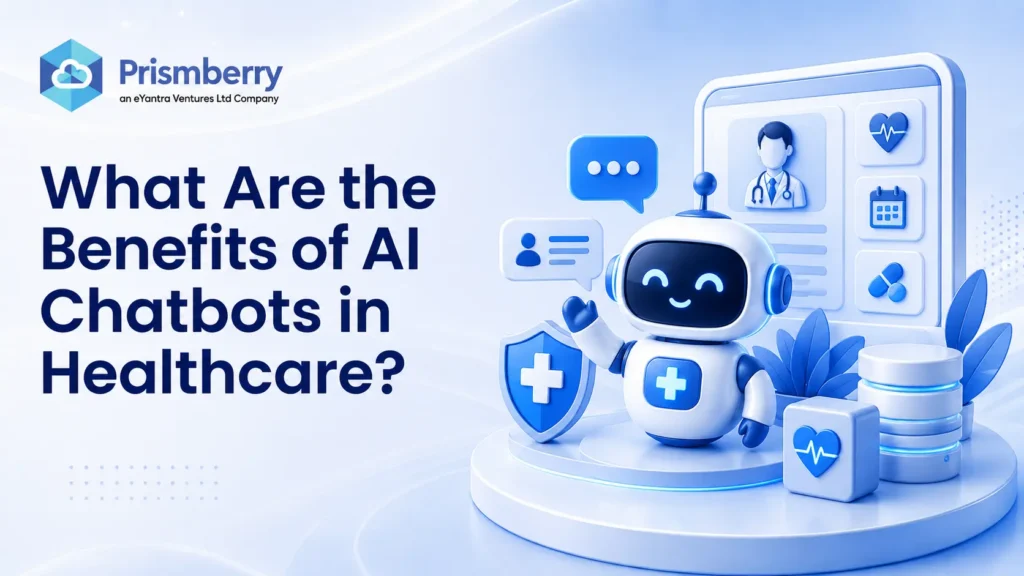
A patient wants to know whether they need to bring previous medical reports to an appointment.
It is a simple question. Yet the patient may have to search a hospital website, call reception, wait for an email, or find the right department before getting an answer.
Now imagine asking that question and getting an immediate response based on the healthcare organization’s approved information.
That is where AI Chatbots in Healthcare are becoming useful.
The opportunity is not about replacing doctors or nurses. It is about removing friction from the parts of healthcare that are repetitive, information-heavy, and administrative.
Patients need help before, during, and after appointments. Healthcare teams need to manage those questions without allowing routine communication to consume all of their time.
A well-designed chatbot can become a digital first point of contact, helping patients find information, navigate services, complete appropriate routine tasks, and reach human support when necessary.
The real question is not whether a chatbot can talk.
It is whether it can make the healthcare journey easier.
What Is AI Chatbots in Healthcare?
AI chatbots in healthcare are conversational systems that use artificial intelligence to communicate with patients, caregivers, healthcare staff, or other users through text or voice.
Depending on the solution, they can answer frequently asked questions, provide information from an approved knowledge base, guide users to services, support appointment-related processes, send reminders, and route requests to the appropriate team.
The chatbot’s role should always be clearly defined.
It can be highly useful for information access and administrative support without becoming a substitute for clinical expertise. Diagnosis, treatment decisions, and other high-risk activities require appropriate professional oversight.
The best healthcare chatbot therefore understands its boundaries. AI handles suitable routine interactions, while people handle situations requiring clinical judgment, empathy, or professional responsibility.
1. Patients Can Get Support Around the Clock
Healthcare questions do not follow office hours.
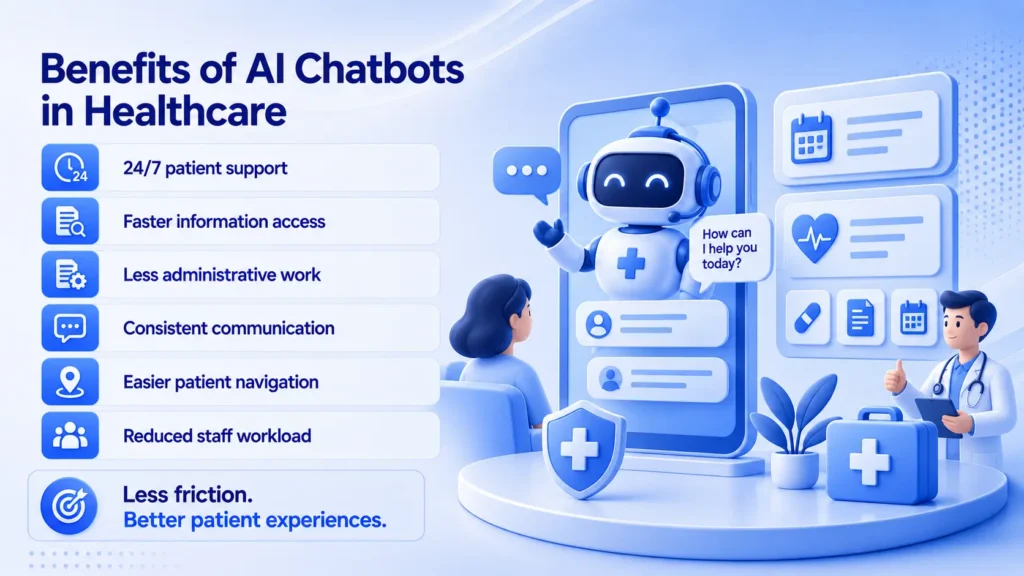
Patients may need basic information late at night, early in the morning, or over a weekend. A chatbot can provide immediate support for routine questions at any time.
It can help with clinic timings, locations, services, appointment processes, documents, and approved preparation information.
This creates an always-available first layer of support.
Patients do not have to wait for every basic question to be answered by a person, while staff remain available for cases that genuinely require human attention.
2. Healthcare Information Becomes Easier to Find
Healthcare websites can contain a huge amount of useful information and still be difficult to navigate.
Patients may know what they need but not know which department, menu, or page contains the answer.
A conversational interface can simplify that experience. Instead of searching through multiple pages, users can ask a question in natural language and receive a response based on approved information.
This is especially useful for hospitals and healthcare organizations with many departments, locations, and services.
However, the chatbot should be connected to reliable content. Automating outdated or incorrect information only makes the wrong answer easier to access.
3. Routine Administrative Work Can Be Automated
A significant part of the patient experience is administrative.
People need help with appointment processes, forms, reminders, locations, documents, and other routine tasks. Staff may answer the same questions hundreds of times.
AI can handle suitable parts of this work.
A chatbot can explain booking steps, collect basic information, provide reminders, or guide a patient toward the correct scheduling channel. With appropriate integrations, it can support more of the workflow.
The result can be a faster patient experience and less repetitive work for administrative teams.
4. Staff Get More Time for Work That Requires People
Not every patient interaction requires a clinician or experienced staff member.
Healthcare teams regularly spend time answering recurring questions about timings, procedures, documents, and services.
A chatbot can handle appropriate first-line requests and leave exceptions to people.
This allows staff to focus on complex cases, patient conversations, coordination, and work requiring professional judgment.
That is one of the strongest practical arguments for AI in healthcare: it can protect human time rather than simply attempt to replace human roles.
5. Patient Communication Can Become More Consistent
Patients should not receive conflicting answers to the same basic question simply because they contacted different teams.
A chatbot connected to an approved knowledge source can provide a consistent starting point for common information.
That can help organizations communicate more reliably about services, locations, processes, and administrative requirements.
There is one important condition: the information must remain current.
Healthcare organizations need ownership of chatbot content, regular reviews, and a process for updating information when policies or procedures change.
6. Patients Can Be Guided to the Next Step
Healthcare journeys can become confusing when patients are unsure what to do next.
A patient may start with a general question and discover that they need a particular department, form, appointment, or type of support.
A conversational system can turn that uncertainty into a clearer next step.
Instead of presenting a long list of information, the chatbot can guide the user through a defined path and explain what action comes next.
Good conversational design is therefore important. The goal is not to give patients more information. It is to help them find the right information and move forward.
7. Personalization Can Reduce Unnecessary Friction
Where appropriate permissions and integrations exist, a chatbot can use relevant context to make conversations more useful.
For example, it may recognize that a patient is asking about an upcoming appointment and provide information relevant to that interaction instead of starting from zero.
But healthcare personalization needs strong controls.
The system should only access information it is authorized to use. It should not make unsupported clinical assumptions or expose sensitive information simply to make a conversation feel personalized.
Good personalization reduces repetition without compromising privacy or safety.
8. A Good Healthcare Chatbot Knows When to Escalate
One of the most important capabilities of a healthcare chatbot is knowing when it should stop.
If a user asks something that requires clinical assessment, describes a potentially urgent problem, or requests information outside the chatbot’s approved scope, the system should direct the person toward appropriate professional or emergency support.
This is not a failure of automation.
It is responsible design.
Healthcare chatbots should have clear escalation rules and communicate their limitations honestly. Their purpose is to support the healthcare journey, not create false confidence that a machine can replace qualified professionals.
The Benefits Are Real, but Healthcare Needs Strong Guardrails
Healthcare is a high-stakes environment, so chatbot implementation requires more than a good conversational interface.
AI can produce inaccurate or incomplete answers. Poorly designed systems can also create privacy, security, or workflow risks.
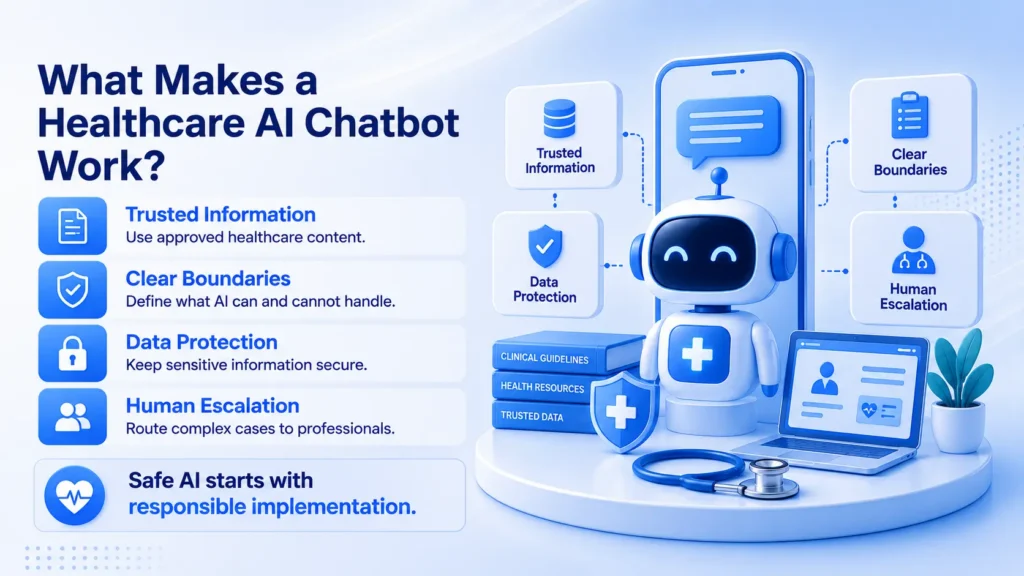
Healthcare organizations should therefore define the chatbot’s scope, use trusted information, protect sensitive data, test the system, monitor performance, and establish human escalation.
The objective should never be to automate everything.
It should be to automate the right things safely.
That distinction is what separates a useful healthcare AI solution from a chatbot that simply generates answers.
What Should Healthcare Organizations Consider Before Implementation?
The starting point should be a real problem, not the technology itself.
Organizations should identify where patients repeatedly ask questions, where staff spend time on repetitive communication, and where digital processes create delays.
Then they should define exactly what the chatbot can do, what information it can access, which situations require escalation, and which topics are outside its role.
The underlying knowledge also needs regular maintenance. A chatbot cannot provide trustworthy support if the information behind it is outdated.
Finally, performance should be measured through practical outcomes such as response time, successful self-service, escalation rates, unanswered questions, patient satisfaction, and staff workload.
The best chatbot is not necessarily the most advanced one.
It is the one that solves the right problem reliably.
How Prismberry Helps Build Healthcare AI Chatbot Solutions
Prismberry helps healthcare organizations build AI solutions around real patient and operational workflows, not just standalone chatbots.
Our solutions can include:
- AI chatbots and virtual assistants
- Knowledge-based AI and workflow automation
- Healthcare system integrations
- Custom AI applications
How It Works
We connect AI with the information, systems, and workflows already used by the organization.
With AgentIQ, Prismberry’s enterprise AI agent framework, organizations can connect policies, SOPs, internal knowledge, patient management systems, scheduling tools, and portals through a governed AI layer.
This allows AI to:
Understand the user’s request → Retrieve trusted information → Guide the next step → Escalate to the right team when human support is required.
The result is a more connected healthcare experience where AI supports both patient engagement and internal operations, while human expertise remains part of the workflow.
Final Thoughts: The Best Healthcare Chatbot Knows Its Limits
The biggest benefit of AI chatbots in healthcare is not that they can hold a conversation.
It is that they can remove friction.
They can make routine information available around the clock, help patients find the right information, reduce repetitive administrative work, support digital journeys, and give staff more time for interactions that require human judgment.
But healthcare needs a higher standard than ordinary automation.
The best chatbot is not the one that tries to answer every question. It is the one that uses trusted information, protects sensitive data, understands its limits, and brings a human into the conversation when expertise matters.
That is the real opportunity for AI in healthcare: not replacing the people patients depend on, but giving those people better tools to support them.
Frequently Asked Questions
They can support routine patient questions, information access, service navigation, appointment-related assistance, reminders, administrative workflows, and other clearly defined support tasks.
No. They should support appropriate tasks rather than replace qualified healthcare professionals. Diagnosis, treatment decisions, and clinical assessment require appropriate professional oversight.
They can provide faster access to routine information, reduce waiting for basic answers, guide patients through digital processes, and make healthcare services easier to navigate.
A general chatbot should not be treated as a substitute for professional medical advice. Clinical or high-risk questions should be directed to appropriate healthcare professionals or services.
Yes. Automated systems can provide routine support outside normal working hours. The availability of human escalation depends on the healthcare organization’s operating model.
They can be used safely for suitable use cases when they have a clearly defined scope, reliable information, privacy and security controls, testing, monitoring, and appropriate human escalation.
Start with a specific patient or operational problem, define the chatbot’s boundaries, connect it to reliable information and relevant systems, establish escalation rules, protect sensitive data, and measure performance continuously.