The amount of PhDs, research lab and $10M budget needed to create an AI-powered application in 2026 are no longer required. The environment of AI application development has changed drastically – nowadays, even solo developers, startups, as well as Fortune 500 engineering teams, can afford to develop high-performance AI application tools.
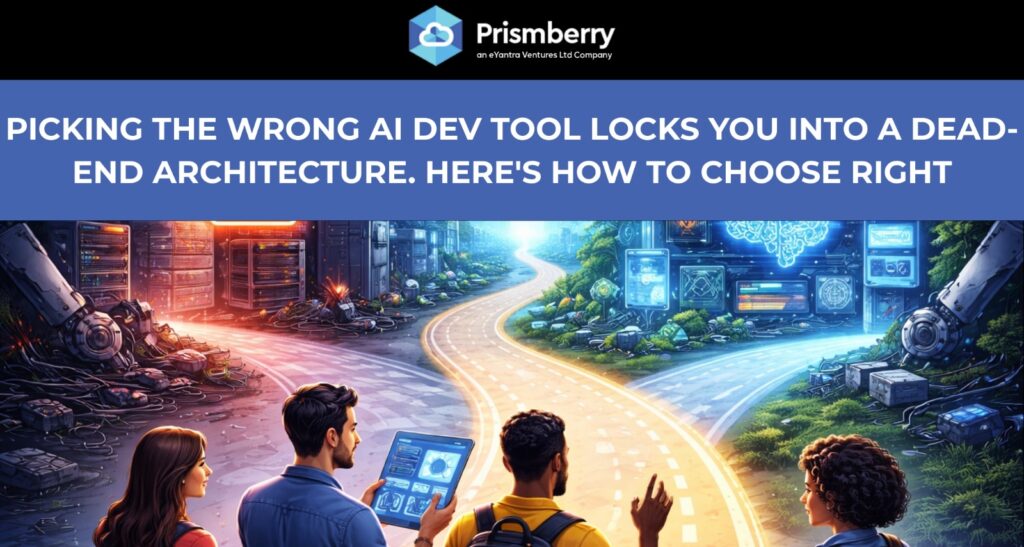
However, when there are hundreds of tools competing to be paid attention to, it is time, money and momentum wasted in the wrong tool. The inappropriate AI development system may put you into a dead-end architecture. The right one will get you idea to production in days.
This list consists of the 10 most potent AI development tools to build AI apps in 2026 – AI coding assistants, full-stack app builders, LLM frameworks, or enterprise AI development platforms. We discuss the purpose of each tool, who each is appropriate, and the price so that you can make the right decision about your project.
What Are AI Development Tools?
The development tools of AI are software, frameworks and services that assist programmers (and non-programmers progressively) in creating, creating, testing and deploying artificial intelligence programs. They have a broad spectrum, including AI coding assistants that complete your code in VS Code, to full-stack developer builders that create an entire web app on a text prompt, to enterprise-scale frameworks to create production LLM pipelines.
The AI app development process has evolved into distinct layers, each requiring different tooling:
- Ideation & prototyping: Rapid UI and app generation tools (Lovable, Bolt.new, v0)
- Code generation & editing: AI coding assistants and IDE agents (GitHub Copilot, Cursor, Claude Code)
- LLM application development: Frameworks for chaining models, agents, and data (LangChain, LlamaIndex)
- Deployment & MLOps: Serving, monitoring, and scaling AI models in production (Hugging Face, AWS Bedrock, Vertex AI)
The AI Software Development Lifecycle
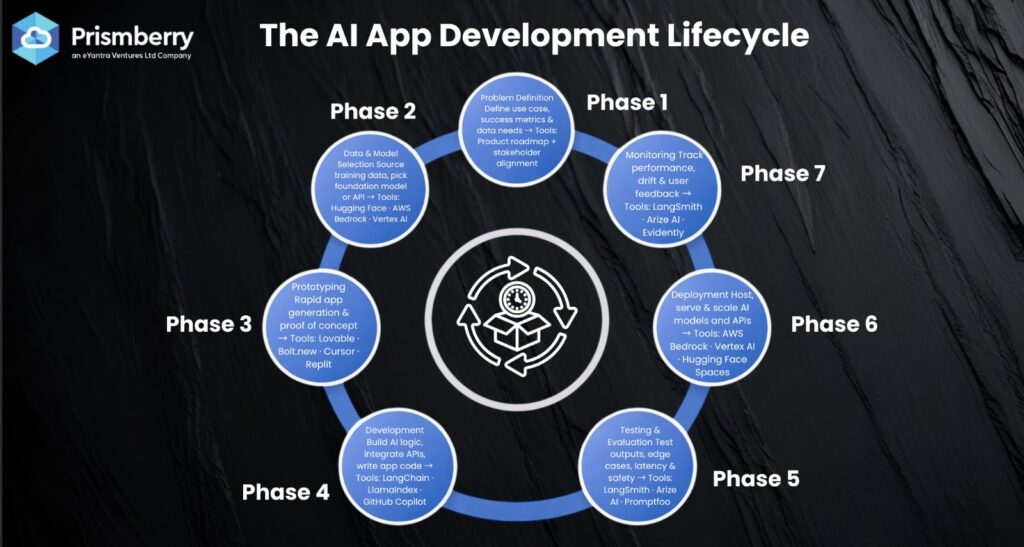
It is best to have a glance at how tools can be incorporated in the AI software development lifecycle (AI-SDLC) before choosing them. In comparison to the classical software development, the construction of AI-based applications consists of a different set of stages:
| Phase | Key Activities | Tools Used |
| 1. Problem Definition | Define AI use case, success metrics, data requirements | Product roadmap tools, stakeholder alignment |
| 2. Data & Model Selection | Source training data, select foundation model or API | Hugging Face, OpenAI API, AWS Bedrock, Vertex AI |
| 3. Prototyping | Rapid UI/app generation, proof-of-concept builds | Lovable, Bolt.new, v0, Replit, Cursor |
| 4. Development | Build AI logic, integrate APIs, write application code | LangChain, LlamaIndex, GitHub Copilot, Cursor |
| 5. Testing & Evaluation | Test model outputs, edge cases, latency, safety | Promptfoo, Trulens, LangSmith, Arize AI |
| 6. Deployment | Host, serve, and scale AI models and APIs | AWS Bedrock, Google Vertex AI, Hugging Face Spaces |
| 7. Monitoring | Track model performance, data drift, user feedback | LangSmith, Arize AI, Evidently |
10 Powerful AI Development Tools for Building AI Apps
1. The World’s Most-Used AI Coding Assistant
GitHub Copilot is directly integrated into VS code and JetBrains IDEs and offers real-time code completions, function generation, test writing, and multi-step refactoring via a Copilot Chat agent. It has 1.3M+ paid subscribers and it is used within companies such as eBay and Shopify to provide AI-assisted coding, which is the industry standard. Most suitable when the team needs AI to save time in an already existing development process but IDEs do not need to be changed.
2. The AI-First IDE Built for Full-Stack Development
Cursor is a rebuilder of VS Code that is based on an AI agent. It is best known by its excellent codebase knowledge you can ask it to refurbish a whole module, bug fix in a batch of files, or provide an explanation of legacy code. Cursor is a system based on Claude and GPT-4 that can be instructed on project-specific AI instructions using SKILL.md. It is particularly effective in a team that is moving legacy systems, developing scalable backend APIs, or a large monorepo. Enterprise data security, SOC 2 certified.
3. From Idea to Full-Stack App Without Writing Code
Lovable lets you describe an app in plain language and generates a complete, deployable React + Supabase application. Its Visual Edits feature lets you click on any UI element and modify it through chat, reducing UI iteration cycles by 40%. Enterprise customers include Klarna, Uber, and Zendesk. In December 2025, Lovable raised a $330M Series B at a $6.6B valuation and hit $200M ARR — making it the fastest-growing AI app builder in history. Ideal for custom AI SaaS application development and rapid MVP launches.
4. The Go-To Framework for LLM Application Development
LangChain is the most widely adopted AI application development framework for building LLM-powered applications. It provides abstractions for chaining prompts, integrating vector databases, building AI agents, and connecting to external tools and APIs. With 90,000+ GitHub stars and used by over 100,000 organizations, LangChain has become the default starting point for custom AI application development. Pair it with LangSmith for production-grade observability and debugging.
5. The AI Model Hub and Deployment Platform
Hugging Face hosts 500,000+ pre-trained models, 150,000+ datasets, and 100,000+ AI demo apps. For AI application development, it’s the fastest way to access state-of-the-art models for NLP, computer vision, speech, and generative AI without building from scratch. Hugging Face Spaces and Inference Endpoints let you deploy models to production in minutes. It’s the backbone of the open-source AI ecosystem and a must-know platform for any AI app development team.
6. Enterprise-Grade Foundation Model Access on AWS
AWS Bedrock provides fully managed access to foundation models from Anthropic (Claude), Meta (Llama), Mistral, Stability AI, and others through a single API. For enterprise AI app development, Bedrock offers model fine-tuning, RAG with Knowledge Bases, AI Agents, and guardrails for responsible AI — all within AWS’s security and compliance framework (HIPAA, SOC 2, GDPR). It’s the preferred choice for enterprises already on AWS that need scalable AI application development services without managing AI infrastructure.
7. Google’s Unified AI Development Platform
Google Vertex AI is an end-to-end AI application development platform covering model training, fine-tuning, deployment, and serving. It provides access to Gemini models, AutoML, and a model garden with 130+ models. Vertex AI Agent Builder lets teams create production RAG applications and AI agents with minimal code. Its tight integration with BigQuery makes it the top choice for enterprises with large analytical data estates who want to build AI-powered applications on top of their existing data.
8. Full-Stack App Building, Entirely in Your Browser
Bolt.new by StackBlitz runs full-stack development in-browser via WebContainer technology — no local setup, no installations. It uses Claude Code and OpenAI models to handle architecture, logic, and deployment. You can click on UI elements, edit code directly, and deploy — all in one tab. It’s the fastest path from prompt to shareable, working prototype for web applications. Teams at companies like Seagate have used similar platforms to ship enterprise portals 5x faster than traditional development.
9. The Data Framework for LLM Applications
LlamaIndex is the leading framework for connecting LLMs to your own data. It provides tools for data ingestion, indexing, retrieval, and query pipelines that make it easy to build Retrieval-Augmented Generation (RAG) applications over private documents, databases, and APIs. With 35,000+ GitHub stars and deep integration with all major LLMs and vector databases, LlamaIndex is essential for any enterprise AI development company building document Q&A, contract intelligence, or enterprise knowledge-base applications.
10. Cloud IDE + AI Agent for Rapid App Development
Replit combines a cloud-based IDE with an AI coding agent that writes backend code, generates UI components, debugs in real time, and deploys — all from a browser tab. Its real-time collaboration makes it strong for distributed teams and educational environments. Replit Agent handles Stripe payments, PDF generation, and role-based access controls without complex setup. It’s the easiest entry point for non-technical founders who want to build AI apps for business without a dedicated engineering team.
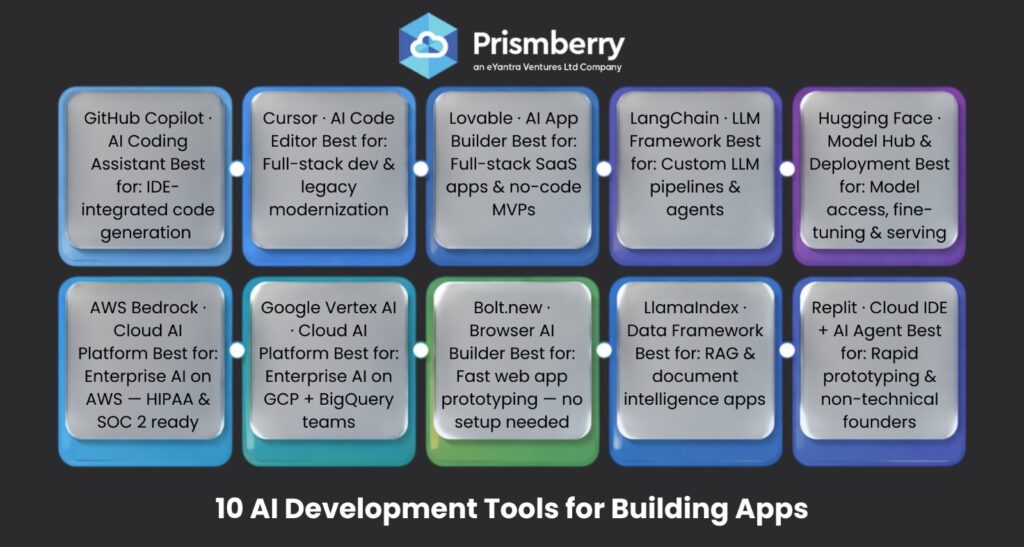
Quick Comparison: Which AI Development Tool Is Right for You?
| Tool | Category | Best For | Starting Price |
| GitHub Copilot | AI Coding Assistant | IDE-integrated code generation | $10/mo |
| Cursor | AI Code Editor | Full-stack dev, legacy modernization | $20/mo |
| Lovable | AI App Builder | Full-stack SaaS apps, no-code MVPs | $25/mo |
| LangChain | LLM Framework | Custom LLM pipelines & agents | Free (open-source) |
| Hugging Face | Model Hub & Deployment | Model access & serving | Free tier |
| AWS Bedrock | Cloud AI Platform | Enterprise AI on AWS | Pay-per-use |
| Google Vertex AI | Cloud AI Platform | Enterprise AI on GCP | Pay-per-use |
| Bolt.new | Browser AI Builder | Fast web app prototyping | Free tier |
| LlamaIndex | Data Framework | RAG & document intelligence apps | Free (open-source) |
| Replit | Cloud IDE + AI | Rapid prototyping & education | Free tier |
AI-Powered Application Examples by Industry
Wondering what you can actually build? Here are real-world AI-powered application examples across industries:
- Healthcare: Medical document summarization (LlamaIndex + Claude), clinical trial matching, AI-assisted diagnostics
- Finance: Real-time fraud detection APIs (AWS Bedrock), AI financial advisors, automated contract review
- E-Commerce: AI product recommendation engines, visual search apps, automated customer support chatbots (LangChain)
- Legal & Compliance: Contract intelligence platforms, regulatory Q&A tools, compliance monitoring dashboards
- Internal Tools: Custom AI SaaS applications for HR, operations, and IT — built in days using Lovable or Bolt.new
Why Choose Prismberry for Your AI Application Development?
Knowing which AI development tools exist is one thing. Building a production-grade AI application that actually delivers ROI is another. That’s where Prismberry comes in.
We are an enterprise AI app development company that designs, builds, and scales custom AI-powered applications across every major industry — using the best tools and frameworks for your specific requirements.
- Full-Stack AI Development – We handle everything — from selecting the right LLM framework and building the AI logic, to designing the UI and deploying to production.
- Custom AI Application Development – No off-the-shelf templates. Every solution is designed around your use case, your data, and your business goals.
- Enterprise AI Expertise – We build with compliance, security, and scalability in mind — SOC 2, HIPAA, GDPR — from day one.
- AI SaaS Development – We help startups and enterprises build, launch, and scale AI SaaS products with the right architecture for growth.
- Hire AI Developers – Need to augment your team? Hire dedicated AI developers from Prismberry — screened, experienced, and ready to ship.
- End-to-End AI Consulting – From tool selection and architecture review to hands-on development and post-launch optimization.
Conclusion
The AI application development landscape in 2026 offers more powerful tools than ever before, but the right choice depends on your use case, team, and goals. GitHub Copilot and Cursor accelerate engineering teams writing code. LangChain and LlamaIndex are the go-to frameworks for LLM application development. Lovable and Bolt.new are transforming how founders build AI SaaS products. AWS Bedrock and Vertex AI give enterprises scalable, compliant foundation model access.
Whether you’re just starting your AI app development journey or looking to build a production enterprise AI application, the tools are there. The key is matching the right tool to the right job — and having the expertise to implement it well.